
Your Voice Assistant is the New Financial Advisor
Managing Your Money Just Got a Lot Smarter
Smart assistant money management refers to using AI-powered apps and voice-enabled tools to automate budgeting, track spending, manage subscriptions, and get personalized financial guidance — often without lifting a finger.
Here are the top smart assistant money management tools worth knowing in 2025:
| Tool | Best For | Starting Price |
|---|---|---|
| Cleo | Conversational budgeting & savings coaching | Free (Plus: $5.99/mo) |
| Albert Genius | All-in-one budgeting, investing & protection | Paid subscription |
| Rocket Money | Subscription tracking & bill negotiation | Free (Premium available) |
| Vera | Privacy-first spending guidance | Free |
| Erica (Bank of America) | In-app voice banking & account management | Free with account |
| U.S. Bank Smart Assistant | Hands-free voice banking | Free with account |
| Frank | AI + human CFP hybrid financial advice | Subscription |
| Intuit Assist | Tax, accounting & small business finance | Varies by product |
Think about the last time you actually sat down to review your budget. If you’re drawing a blank, you’re not alone.
Nearly one in four Americans have zero emergency savings, yet only 26% of AI users are currently asking chatbots for financial help. That gap is shrinking fast — 59% of Americans have already used a chatbot for something, and among those who use AI for finance, 61% use it to manage personal finances.
The tools are here. They’re smarter than ever. And they’re no longer just for finance geeks with spreadsheets.
Today’s AI finance assistants go far beyond your bank’s basic app. They analyze your spending patterns, flag forgotten subscriptions draining your account, automate savings you won’t even miss, and some will even give you a friendly (or brutally honest) reality check on your habits.
The result? Users of popular tools like Cleo and Rocket Money report saving anywhere from $80 to $500 per year — often just by shining a light on where their money was quietly disappearing.

The Rise of Smart Assistant Money Management
The shift from manual spreadsheets to smart assistant money management isn’t just about convenience; it’s a technological leap. Traditional banking apps are reactive—they show you what you’ve already spent. AI-powered assistants are proactive. By leveraging Natural Language Processing (NLP), Machine Learning (ML), and Generative AI, these tools can “read” your financial life, understand your intent, and offer predictive insights.
For instance, while a standard app might show a $50 charge for a utility bill, a smart assistant like Bank of America’s Erica can notify you that the recurring charge increased compared to last month. This proactive alerting is why 61% of U.S. consumers who use AI chatbots for finance focus on personal management, while 42% use them for stock analysis.
We are seeing a massive reduction in “financial anxiety.” In the UK, nearly one in four adults aged 28 to 40 face significant money stress despite feeling confident. AI assistants bridge this gap by offering a non-judgmental “money buddy” that works 24/7. Whether it’s tracking public assistance (used by 40% of chatbot users) or finding the best time to book a flight, these assistants take the cognitive load off our shoulders.
Exploring Diverse Models of AI Financial Guidance
Not all AI assistants are built the same. Depending on whether you want a digital “coach” to roast your spending habits or a high-security vault for your documents, there is a model designed for you.
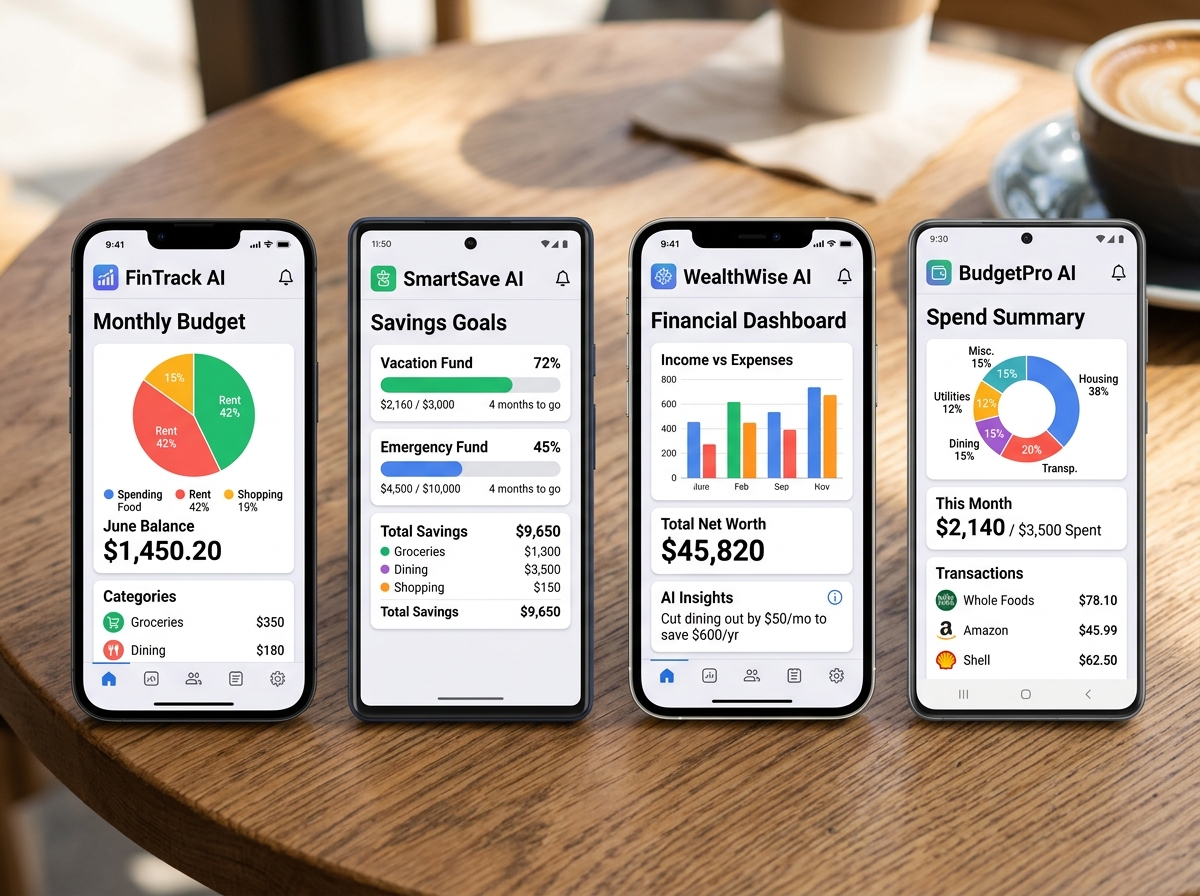
Personality-Driven Conversational Coaching
Some of the most popular tools, like Cleo, have abandoned “bank-speak” for a personality-driven approach. Cleo, which has over 6 million users, uses a chatbot interface that feels like texting a friend. It can “roast” you for spending $100 at Starbucks or “boost” you when you hit a savings goal.
These apps use machine learning to “conquer machine spending.” By making money management engaging, users report saving 15-20% more than with traditional apps. Pricing usually follows a freemium model: basic tracking is free, while premium tiers (like Cleo Plus for $5.99/month or Builder for $14.99/month) offer credit building and salary advances.
Comprehensive Financial Management Platforms
If you want one tool to rule them all, platforms like Albert provide an all-in-one ecosystem. Their Genius feature doesn’t just give advice—it acts on it. It can move money to savings automatically, find insurance deals, and even plan travel itineraries.
Albert has managed over $13 billion in transactions and helped users save or invest more than $2 billion. These platforms often include identity protection, dark web monitoring, and up to $1 million in ID theft insurance, making them a “financial bodyguard” in your pocket.
Privacy-Focused Financial Guidance
For those wary of data sharing, Vera offers a privacy-first alternative. Vera positions itself as a “digital money coach” that is calm and supportive. Unlike many fintech tools that monetize by selling user data or pushing credit card referrals, Vera implements bank-level AES-256 encryption and a no-selling policy. It uses a “SafeSpending” feature to answer the golden question: “Can I afford this?” by calculating your upcoming bills against your current balance in real-time.
Integrated Human-AI Financial Advisory
The newest trend is the hybrid model, exemplified by Frank. Frank combines AI’s 24/7 monitoring with access to human Certified Financial Planners (CFPs). This is perfect for the “middle class” who might have complex questions about 401(k) concentration, student loan strategies, or homebuying but don’t want to pay $200/hour for a traditional advisor. You can even customize Frank’s persona—choosing how “he” looks and sounds—to make the advice feel more relatable.
Key Features and Voice-Activated Banking
The true power of smart assistant money management lies in features that run in the background. We often talk about Easy Energy Saving Smart Devices here at FinMoneyHub, and financial AI works similarly—optimizing your “output” (spending) with minimal effort.
Automated Savings and Subscription Tracking
Most of us are “hemorrhaging” $50 to $100 a month on forgotten subscriptions. Tools like Rocket Money identify these leaks and can even handle the cancellation process for you. Beyond cutting costs, AI uses “autopilot” features to analyze your cash flow and move small amounts of money to savings that you won’t even miss. For example, Albert | Your personal financial assistant uses these smart deposits to help users build emergency funds effortlessly.
For travelers, apps like Hopper use AI to predict flight prices with 95% accuracy, saving users 20-40%. Even energy consumption is getting the AI treatment; GridRewards NYC users saved an average of $80 a year simply by responding to AI prompts to reduce energy during peak demand. You can learn more about this in our guide on Energy Saving Tips with Smart Devices.
Voice-Activated Banking and Smart Assistant Money Management
Voice is the new frontier. U.S. Bank and Bank of America have integrated voice assistants directly into their mobile apps. You can ask, “Hey, what’s my balance?” or “Lock my debit card,” and the assistant executes the command instantly.
This hands-free approach is a game-changer for accessibility and multi-tasking. Erica, for example, can search through years of transactions via voice or help you schedule Zelle payments. If you’re just starting, check out our Beginner-Friendly Voice Assistant Tips to see how to integrate these commands into your daily routine.
Security, Privacy, and Future Outlook
When you link your bank account to an AI, security is the top priority. Most reputable apps use Plaid, an industry-standard API, to connect to your bank without ever seeing your login credentials.
Key Security and Privacy Features
- Bank-Level Encryption: Most apps use AES-256 encryption, the same standard used by major banks.
- Data Masking: For tools like Erica, voice transcripts are saved for 90 days to improve accuracy, but personal identifiable information (PII) is masked.
- No-Selling Policies: Privacy-first apps like Vera explicitly state they do not sell your data to third parties.
- Security Meters: Some assistants provide a “security meter” to help you monitor your own account safety.
If you are setting up your first smart home ecosystem, understanding these layers is vital. See our guide on First Steps to Mastering Smart Home Assistants for more on securing your digital life.
Choosing Your Smart Assistant Money Management Tool
How do you pick the right one?
- Identify your pain point: If it’s overspending on takeout, choose a conversational coach like Cleo. If it’s investing, look at Albert | Genius.
- Check Bank Compatibility: Most apps rely on Plaid. If your bank is a small local credit union, you might need an app that supports manual CSV uploads.
- Cost vs. Reward: If an app costs $10/month but saves you $100/month in negotiated bills, the ROI is clear.
The Future of AI Personal Finance
The future of smart assistant money management is global and deeply personalized. We are moving toward “enhanced memory,” where your AI remembers that you’re saving for a wedding in two years and automatically adjusts your “Safe to Spend” limit when you’re at a jewelry store.
We also expect to see more “GenAI” integration, like Intuit Assist, which works across TurboTax and QuickBooks to provide a holistic view of both personal and small business taxes. The goal is the democratization of financial wellness—giving everyone the level of advice previously reserved for the ultra-wealthy.
Frequently Asked Questions about Smart Assistant Money Management
How do AI assistants differ from traditional banking apps?
Traditional banking apps are digital ledgers—they show you what happened. AI assistants are proactive advisors. They use machine learning to predict future spending, identify trends (like a utility bill increase), and offer actionable advice or automated actions (like cancelling a subscription).
Are AI financial assistants safe and private?
Yes, provided you use reputable tools. Most use bank-grade encryption and third-party integrators like Plaid to ensure they never store your actual bank passwords. Always look for a “no-selling” data policy in the app’s privacy settings.
How much do these smart finance tools cost?
Many offer a robust free tier for basic budgeting and tracking. Premium subscriptions typically range from $2.99 to $14.99 per month. These paid tiers usually unlock features like credit building, automated investing, or bill negotiation services.
Conclusion
The era of the “passive” bank account is over. With smart assistant money management, your phone is no longer just a place to check your balance—it’s a proactive partner in your financial health. Whether you’re using Cleo: Your AI-Powered Financial Wellness Companion to get your spending under control or Frank | Smarter Financial Advice for the Middle Class to plan for retirement, the technology is now accessible to everyone.
At FinMoneyHub, we believe that mastering your digital devices is the key to a better life. By setting up complex command capabilities and smart routines, you can turn your voice assistant into the best financial advisor you’ve ever had. Start mastering your smart assistant today and take the first step toward effortless financial wellness.
