
The Smart Home Revolution Is Already Here — Are You In?
Home automation IoT devices are physical gadgets — thermostats, locks, lights, cameras, and more — that connect to the internet and work together to make your home smarter, safer, and more efficient.
Here’s a quick look at the most common types and what they do:
| Device Type | What It Does |
|---|---|
| Smart thermostat | Learns your schedule, adjusts temperature automatically |
| Smart lighting | Turns on/off based on occupancy or time of day |
| Video doorbell | Lets you see and speak to visitors remotely |
| Smart lock | Locks/unlocks via app or voice command |
| Robot vacuum | Cleans floors on a schedule without lifting a finger |
| Smart speaker/display | Controls all your devices with voice commands |
| Leak/motion sensor | Sends real-time alerts to your phone |
| Smart plug | Turns any appliance into a connected device |
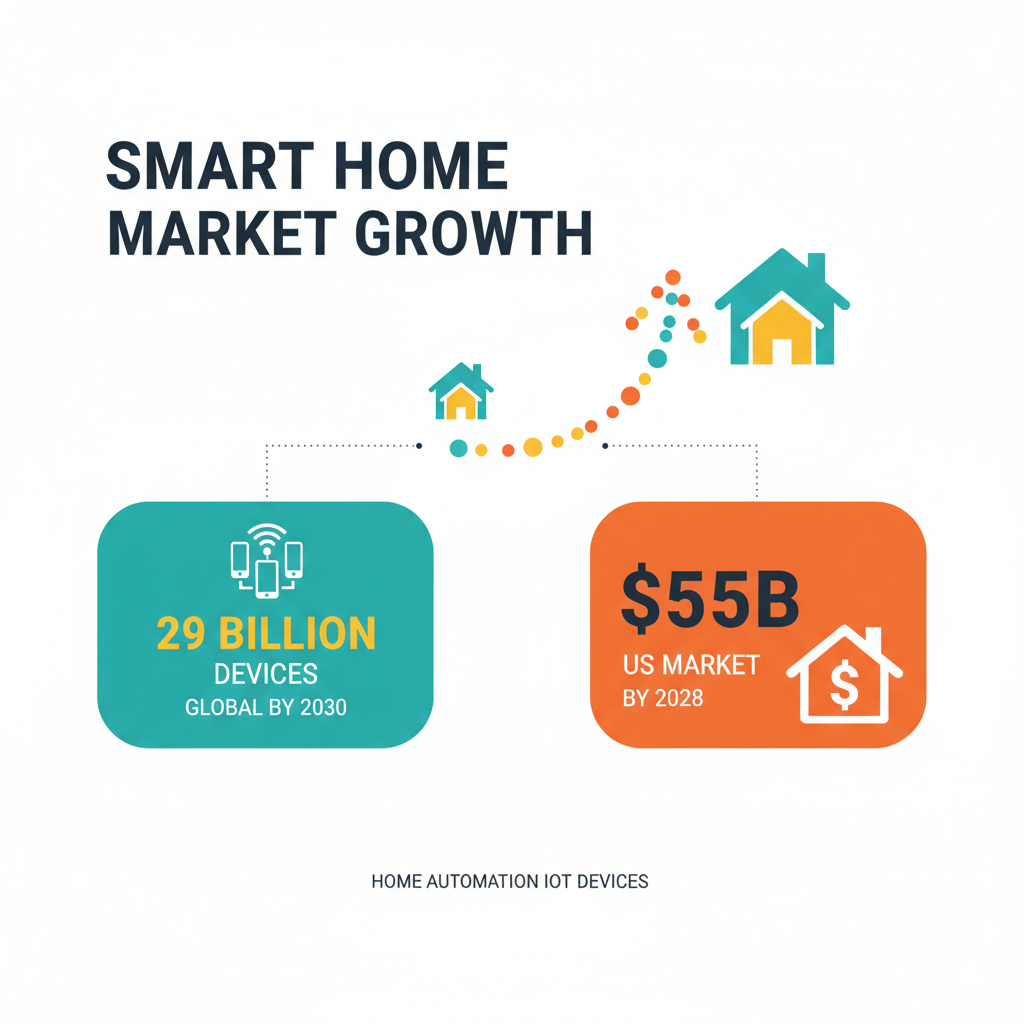
The numbers tell a clear story. There are expected to be as many as 29 billion IoT-connected devices worldwide by 2030. The US smart home market alone is projected to hit $55 billion by 2028 — up nearly 59% from 2023.
And it makes sense. Imagine waking up to your favorite music, your coffee already brewing, and your home at the perfect temperature — all without touching a single switch. That’s not a far-off fantasy. It’s what a well-set-up smart home does right now.
Whether you’re tired of juggling apps for a dozen different gadgets or just getting started, this guide breaks down exactly which devices are worth your time and money.
The Core Benefits of Home Automation IoT Devices
When we talk about home automation iot devices, we aren’t just talking about fancy toys for tech enthusiasts. We are talking about a fundamental shift in how our living spaces function. The primary driver for most of us is the sheer convenience—the ability to control your entire world from a smartphone or a simple voice command. But the benefits run much deeper than just not having to get off the couch to dim the lights.
One of the most significant impacts is on the planet and your wallet. Research shows that home automation can cut a household’s carbon emissions by approximately 13%. In fact, the city of Nottingham in the UK saw a 26% reduction in emissions since 2005, thanks in large part to the adoption of these technologies. Beyond the environment, you’ll see a direct impact on your monthly expenses, with typical bill reductions ranging between 5% and 22%.
For many of our readers, energy-saving tips with smart devices are the first step toward a more sustainable lifestyle. These devices offer remote monitoring, allowing you to check if you left the oven on or if a pipe is leaking while you’re at work. Furthermore, they provide essential elderly assistance, allowing seniors to live independently longer through fall detection and automated lighting that prevents trips in the dark.
Maximizing Energy Efficiency and Cost Savings
If you want to see an immediate return on your investment, look no further than climate control. Smart thermostats are the heavy hitters here. Scientific research on smart thermostats indicates that these devices can cut energy usage by 10% to 15%. They don’t just follow a timer; they learn your habits and use occupancy sensors to ensure you aren’t heating an empty house.
If you are just starting, a smart thermostat setup for beginners is one of the most effective weekend projects you can tackle. Pair this with smart lighting, and the savings multiply. Smart bulbs can save between 7% and 27% on energy. By integrating easy energy saving smart devices, you can even take advantage of grid incentives, where your home automatically reduces power consumption during peak times to help stabilize the local electrical grid.
Enhancing Home Security and Safety
Security is where home automation iot devices truly shine, providing peace of mind that traditional locks simply can’t match. Modern systems utilize a combination of video doorbells, smart locks, and motion sensors to create a digital perimeter around your property.
Aqara – Smart Home Automation Devices for Better Living – Aqara LLC offers a suite of tools that enable 360-degree monitoring. These devices don’t just watch; they act. For example, a leak detector can shut off your main water valve the second it senses moisture under the dishwasher, potentially saving you thousands in repair costs. With simple home automation routines, you can program your lights to flicker if a smoke detector is triggered, ensuring that even those with hearing impairments are alerted to danger immediately.
Essential Home Automation IoT Devices for Every Room
Building a smart home doesn’t have to happen all at once. We usually recommend starting room by room. The kitchen and living room are often the best places to begin because they are the “high-traffic” areas of your digital life.

When planning your budget, it helps to see the price gap between a starter kit and a fully integrated mansion:
| Setup Level | Estimated Cost (USD) | Key Features |
|---|---|---|
| Basic | $300 – $500 | 1-2 Speakers, Smart Bulbs, 1 Plug |
| Advanced | $1,000 – $5,000 | Multi-room Audio, Smart Thermostat, Security Cameras |
| Professional | $10,000+ | Full HVAC Integration, Automated Blinds, Custom Hubs |
The centerpiece of these rooms is usually a smart speaker or display. Whether you prefer a simple Google Home setup or an easy setup for Alexa at home, these devices act as the “brain” of your operation.
Climate Control and Lighting Solutions
To get the most out of your home’s atmosphere, you need a mix of high-end hardware and clever software. The Smart Thermostat Premium is a top-tier choice that includes indoor air quality monitoring and a built-in smart speaker. If you’re looking for something more budget-friendly, the Smart Thermostat Essential provides the core energy-saving features without the extra bells and whistles.
Lighting is the quickest way to change the “vibe” of a room. Using a smart assistant for controlling lights allows you to set scenes like “Movie Night” or “Focus Mode” with a single word. For a robust setup, the Hub M1S – Aqara acts as a bridge, connecting up to 128 devices while offering built-in RGB lighting and illumination sensors. If you’re feeling overwhelmed by the choices, our guide on unveiling the best smart lighting options can help you narrow down the field.
Smart Kitchen and Cleaning Gadgets
The kitchen is undergoing a “culinary paradigm shift.” We now have refrigerators with internal cameras so you can check if you’re out of milk while standing in the grocery aisle. Connected ovens allow for remote preheating, and smart coffee makers can be programmed to have a fresh brew waiting the moment your alarm goes off.
Easy smart appliance automation isn’t just about cooking, though. It’s about reclaiming your time. Robot vacuums have evolved from bumping into walls to sophisticated machines that can map your home and even empty their own dustbins. By checking out some simple home automation ideas, you can find ways to link your cleaning schedule to your location—ensuring the vacuum only runs when you’re out of the house.
Interoperability: How Hubs and Protocols Connect Your Home
The biggest headache in the IoT world is getting devices from different brands to talk to each other. This is where protocols like Zigbee 3.0, Z-Wave, Matter, and Thread come in. Think of these as the “languages” your devices speak.
Matter is the newest kid on the block, backed by industry giants to ensure that a device bought today will work with Alexa, Google, and Apple HomeKit simultaneously. To manage these connections, you often need a physical hub. The Cube T1 Pro is a unique example of a controller that uses gestures—like shaking or rotating—to trigger complex scenes across your home.
For those interested in the technical backbone, platforms like AWS IoT and Semtech LoRa provide the infrastructure for long-range, low-power connectivity. This is especially useful for sensors located far from the main router, such as gate sensors or garden monitors. If you find yourself struggling with a fragmented system, connecting multiple smart assistants can help bridge the gap. And don’t forget the humble smart plug; a beginner guide to smart plugs will show you how to bring “dumb” appliances into your modern ecosystem.
Security, Privacy, and the Cost of a Connected Life
We have to address the elephant in the room: privacy. When your house is filled with microphones and cameras, security must be your top priority. Using home automation iot devices requires a proactive approach to digital hygiene. This means implementing strong, unique passwords for every device and ensuring that firmware updates are installed the moment they are released to patch potential vulnerabilities.
The cost of a connected life isn’t just the price tag on the box. While a basic setup might only cost $300-$500, a comprehensive system can easily reach $10,000. However, you can mitigate these costs by looking for subscription-free options that process data locally rather than in the cloud. Using simple voice control for smart gadgets is a great way to interact with your home without needing expensive custom control panels. For those on a budget, there are plenty of affordable smart assistants for home that provide 90% of the functionality of premium models at a fraction of the price.
The Future of Smart Living: AI, Edge Computing, and Beyond
The next generation of home automation iot devices won’t just wait for your commands; they will anticipate them. This is the promise of Artificial Intelligence (AI) and Machine Learning (ML). Instead of you setting a schedule for your lights, the house will observe your patterns and realize that you usually want the hallway lights at 20% brightness when you get a glass of water at 2 AM.
Edge computing is another game-changer. By processing data on the device itself (at the “edge”) rather than sending it to a distant server, we get low-latency processing. This means your smart lock opens the millisecond it sees your face, rather than waiting for a round-trip to the cloud. We are also seeing the rise of satellite connectivity for rural smart homes and AR integration, where you could point your phone at a wall to see the “virtual” controls for the hidden speakers inside. To stay ahead of the curve, start experimenting with the best routines for smart assistants to see how autonomous your home can truly become.
Frequently Asked Questions about Home Automation IoT Devices
What are the best smart devices for home security?
The most effective security setup usually starts with a video doorbell and smart locks for the front and back doors. To round it out, add motion sensors and window/door contact sensors. Brands like Aqara and Arlo are highly recommended for their high-resolution feeds and ability to integrate with larger ecosystems.
How do smart home hubs enable device interoperability?
A hub acts as a central translator. If you have a light bulb that speaks Zigbee and a sensor that speaks Bluetooth, they can’t talk directly. The hub “listens” to both and allows you to create an automation where the Zigbee bulb turns on when the Bluetooth sensor detects motion. This is the key to a seamless experience.
What is the estimated cost for a basic IoT home system?
A basic, entry-level system typically costs between $300 and $500. This usually includes a smart speaker (like an Echo Pop or Nest Mini), a few smart bulbs, a smart plug, and perhaps a budget-friendly smart thermostat. This is enough to get a feel for the convenience without a massive financial commitment.
Conclusion
At FinMoneyHub, we believe that technology should work for you, not the other way around. The world of home automation iot devices is vast and occasionally intimidating, but the rewards—in terms of energy savings, security, and pure “cool factor”—are undeniable. Whether you are looking to shave 20% off your electric bill or simply want your house to greet you when you walk through the door, the tools are now more accessible than ever.
We specialize in helping you master easy, yet complex command capabilities for your smart devices. Ready to take the next step in your smart home journey? Explore more info about smart assistant services and let us help you turn your house into a home that’s actually on your side.
