
The Ultimate Loyalty Points Tracker Routine
Why Loyalty Points Tracker Routines Are the Key to Real Customer Retention
Loyalty points tracker routines are the structured habits and processes businesses use to monitor, analyze, and optimize their loyalty programs on a daily, weekly, and monthly basis.
Here’s a quick overview of an effective loyalty points tracker routine:
- Daily – Check active member counts, new enrollments, and real-time points balances
- Weekly – Review redemption rates, spot drop-offs, and send re-engagement reminders
- Monthly – Analyze cohort trends, calculate ROI, and adjust reward structures
- Per campaign – Measure incremental revenue lift against non-member control groups
Someone signs up for your loyalty program. You celebrate. Then — silence. No return visit. No points redeemed. No sign they remember your brand exists.
This is one of the most common problems businesses face with loyalty programs. And it happens because tracking enrollment isn’t the same as tracking loyalty.
A high signup number looks great on a report. But it tells you almost nothing about whether your program is actually working.
The real question is: what happens after someone joins?
That’s exactly where loyalty points tracker routines come in. Instead of glancing at surface-level stats, a proper routine digs into behavioral patterns — how often customers return, whether they redeem rewards, and when they start drifting away.
According to industry data, brands that track and optimize loyalty program ROI consistently see stronger year-over-year revenue and better customer retention. One travel company saw a 70% increase in returning customers simply by tightening how they measured and responded to loyalty data.
The difference between a loyalty program that grows your business and one that quietly drains your budget often comes down to how consistently and deeply you track it.
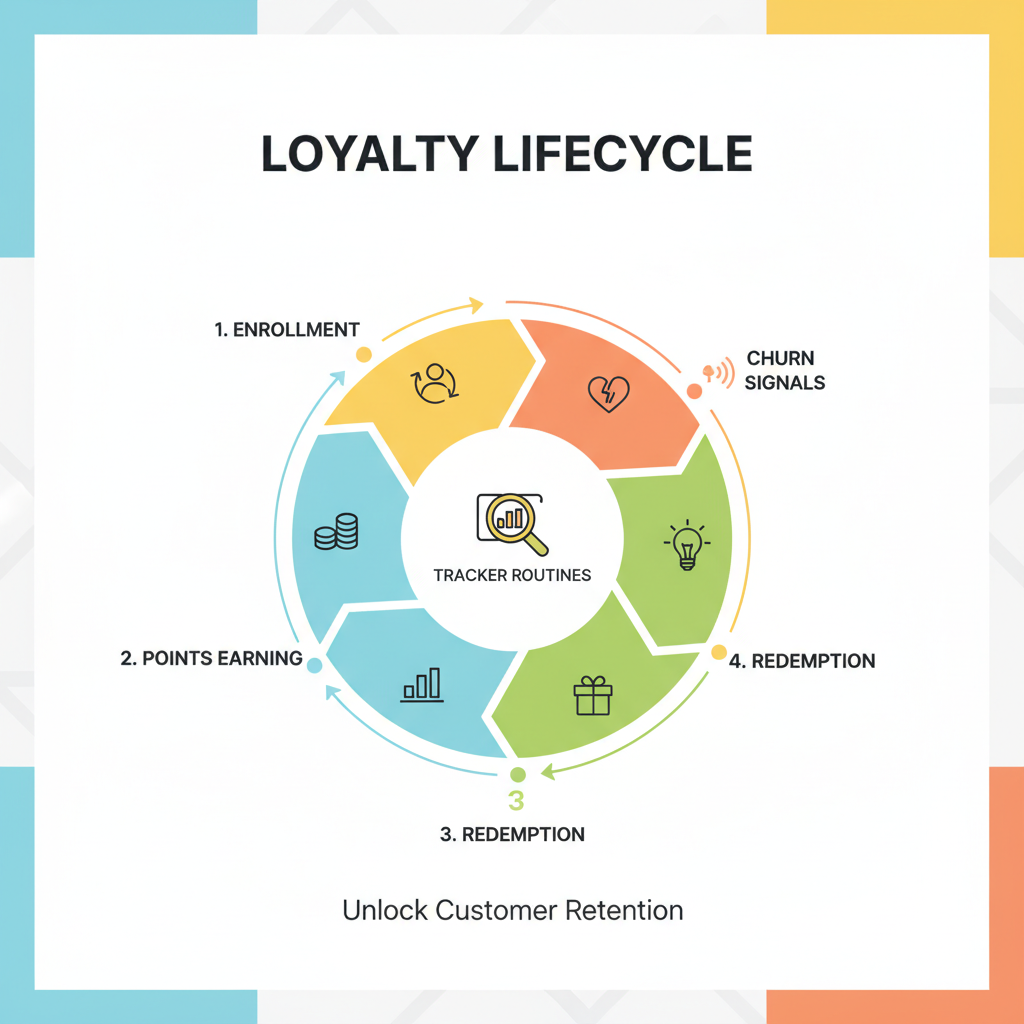
Understanding Loyalty Points Tracker Routines in 2026
In 2026, loyalty is no longer a “promise” made by a customer; it is a “pattern” identified by a business. Traditional loyalty programs often focused on a simple transaction: “Buy ten, get one free.” But modern loyalty points tracker routines have evolved into sophisticated data systems that predict future behavior.
A loyalty points tracker differs from a traditional program because it provides a real-time ledger of engagement. While a traditional program might live on a paper punch card in a customer’s wallet, a tracker lives in the cloud, syncing across POS systems, e-commerce apps, and even smart home devices.
Why Routines are Essential for 2026
As we move further into a digital-first economy, customer attention is the rarest commodity. We’ve found that businesses focusing on omnichannel integration—where points are tracked seamlessly whether a customer buys online, in-app, or in-store—see significantly higher engagement.
Personalization is the heart of 2026 loyalty. By using a routine to monitor data, we can move away from “one-size-fits-all” discounts and toward predictive analytics. For example, if our data shows a customer usually buys every 14 days but hasn’t visited in 20, our routine should trigger an automated “We miss you” bonus. This shift from reactive to proactive management is what defines a successful tracker routine.

Essential KPIs and Metrics for Success
To run an effective routine, we need to know which numbers actually move the needle. Many businesses get trapped by “vanity metrics”—numbers that look good on paper but don’t result in profit.
| Metric Category | Vanity Metric (Avoid Focusing Solely on These) | Behavioral Metric (The Real Gold) |
|---|---|---|
| Growth | Total number of signups | Net Membership Change (Acquisition minus Churn) |
| Engagement | Total points issued | Redemption Rate (Points used vs. Points earned) |
| Value | Average transaction size | Customer Lifetime Value (CLV) |
| Experience | App downloads | Customer Effort Score (CES) |
Key Metrics Defined
- Redemption Rate: This is perhaps the most important health indicator. A high redemption rate (50% or more) means customers value your rewards. If people earn points but never spend them, your program is failing to motivate them.
- Activation Rate: The percentage of new members who take a meaningful action (like a second purchase or a profile completion) within the first 30 days.
- Churn Prediction: By tracking the “time between purchases,” we can identify when a loyal fan is turning into a “dead soul”—a member who still has an account but no longer interacts.
Calculating Metrics for Effective Loyalty Points Tracker Routines
To truly understand if our loyalty points tracker routines are delivering value, we have to do a bit of math. Don’t worry, we’ll keep it simple!
Loyalty Program ROI:
ROI = (Net Profit from Loyalty Members – Program Costs) / Program CostsIf your program costs $1,000 a month to run (including rewards) but generates $5,000 in incremental profit, your ROI is 400%.Customer Retention Rate:
Retention = ((Total Customers at End of Period – New Customers Gained) / Customers at Start of Period) × 100Tracking this by “cohort” (grouping people by the month they joined) helps us see if our program is getting better or worse over time.Active Buying Member Rate: Instead of looking at everyone who ever signed up, we only look at members who have made a purchase in the last 90 days. This prevents “vanity inflation.”
Customer Effort Score (CES): This measures how easy it is for a customer to use their points. In 2026, if it’s hard to redeem a reward, customers will simply go elsewhere. We measure this via quick one-question surveys after a redemption.
How to Build Sustainable Tracking Habits
Building a routine isn’t about spending eight hours a day staring at spreadsheets. It’s about creating a “Real-Time Ledger” mindset. Whether you are a small cafe or a B2B enterprise, your routine should be segmented into manageable chunks.
The Daily Pulse
Every day, we should take five minutes to check the “vital signs.” Are there any technical errors? Did a sudden spike in point issuance happen (which could signal fraud or a viral social post)? Using tools like Lark’s Loyalty Points Tracker can help centralize this data in one dashboard.
The Weekly Pivot
This is where we look for patterns. We analyze point velocity—how fast are people earning versus spending? If points are accumulating too fast without being redeemed, we might have a “reward breakage” problem where the rewards aren’t enticing enough. This is the time to send inactivity reminders or “mid-way bonuses” (e.g., “You’re only 10 points away from a free coffee!”).
The Monthly Strategy
Once a month, we zoom out. We look at Member Growth Rate and Participation Rate. Are we reaching a large enough percentage of our total customer base? We also perform A/B testing on our rewards. Does a “20% off” coupon drive more repeat visits than a “Free Mystery Gift”?
Optimizing Weekly Loyalty Points Tracker Routines
To keep the momentum going, we recommend focusing on engagement scores. You can create a custom score that weights different actions:
- 1 point for an app login
- 5 points for a referral
- 10 points for a reward redemption
By tracking these scores weekly, we can spot “Engagement Trends.” If a specific segment of customers (like “Weekend Shoppers”) sees a drop in their engagement score, we can pivot our marketing strategy immediately rather than waiting until they’ve already churned.
Automation and Smart Assistant Integration
This is where we at FinMoneyHub really get excited. In 2026, manual data entry is a relic of the past. To make your loyalty points tracker routines truly sustainable, you need to automate the heavy lifting.
Using Smart Assistants for Monitoring
Imagine waking up and asking your smart speaker, “Hey, what was our loyalty redemption rate yesterday?” By integrating your loyalty platform with smart assistants, you can get verbal reports while you make your morning coffee.
- Check out our guide on easy-smart-assistant-routines to see how to start linking your business data to your home devices.
- For more advanced setups, our article on best-routines-for-smart-assistants covers how to trigger alerts when a KPI falls below a certain threshold.
No-Code Automation with Zapier
You don’t need to be a developer to build a world-class tracking system. Using Loyalty Program Automation , you can connect your POS (like Shopify or WooCommerce) to your CRM and your tracking spreadsheet instantly.
- Trigger: A customer makes a purchase.
- Action: Zapier updates their points in your tracker, sends a personalized “Welcome” or “Progress” email, and logs the transaction in your monthly ROI report.
Using real-time webhooks ensures that your data is never “stale.” When a customer redeems a point in-store, their digital app balance should update before they even leave the counter.
Industry-Specific Applications and Pitfalls
Different industries require different loyalty points tracker routines. What works for a high-frequency coffee shop won’t work for a low-frequency B2B software company.
Retail and E-commerce
Retailers should focus on Average Order Value (AOV) lift. For example, using the WooCommerce Loyalty Plugin allows you to set up “Gamification” routines where customers earn badges for social sharing or trying new product categories. This turns a boring shopping trip into a challenge.
Parenting and Behavior Tracking
Points aren’t just for profit; they are powerful tools for behavior change. Apps like “Points” or “Privilege Points” help parents manage chores and ADHD routines. By awarding points for positive habits and deducting them for negative ones, parents create a visual “reward ledger” that teaches children time management and responsibility.
Cafes and Small Service Businesses
For local shops, the “Digital Stamp” is king. Tools like Stamp Me replace the lost paper cards of the past. The routine here is simple: track “Visit Frequency.” If a regular hasn’t been in for a week, the system automatically sends a “We have a fresh batch of muffins waiting for you” notification.
B2B Loyalty
In B2B, loyalty is often about “Education and Referrals.” We track points for attending webinars, completing product training, or referring other businesses. The goal is to increase the “Patronage Ratio”—the percentage of their total category spend that goes to your brand versus competitors.
Common Pitfalls to Avoid
- Vanity Metrics: Don’t get distracted by “Total Members.” Focus on “Active Buying Members.”
- Cohort Drift: If you don’t track by the month users joined, you won’t notice if your new members are churning faster than your old ones.
- Data Isolation: Ensure your loyalty data isn’t stuck in one app. Use Loyali Features to sync data across your entire tech stack.
- Ignoring Privacy: In 2026, data security is non-negotiable. Ensure your tracker is GDPR compliant and uses encryption.
Frequently Asked Questions about Loyalty Points Tracker Routines
What is the ideal redemption rate for a healthy loyalty program?
We generally look for a redemption rate of 50% or higher. If your rate is lower than 20%, it usually means your rewards are too hard to reach or simply aren’t attractive to your customers. High redemption means high engagement, which leads to higher long-term retention.
How often should I review my loyalty points data?
We recommend a “Daily Check, Weekly Pivot, Monthly Strategy” routine. Spend 5 minutes daily on health checks, 30 minutes weekly on engagement patterns, and 2 hours monthly on deep-dive ROI analysis and strategy adjustments.
Can I automate points tracking for my small business?
Absolutely! You don’t need a massive budget. Using a Point-Based Rewards Tracking App or a simple Lark Template can automate the math for you. Combined with Zapier, you can have a fully automated system running for the price of a few cups of coffee a month.
Conclusion
At FinMoneyHub, we believe that the future of business is built on smart, automated relationships. Implementing consistent loyalty points tracker routines isn’t just a marketing tactic; it’s a fundamental business strategy for 2026 and beyond. By moving away from “gut feelings” and toward data-driven habits, you can turn one-time shoppers into lifelong advocates.
Whether you’re using smart assistants to monitor your KPIs or no-code tools to sync your ledgers, the key is consistency. Start small—pick one metric to track this week—and build your routine from there.
Ready to take your automation to the next level? More info about smart assistant services can help you bridge the gap between your loyalty data and your daily digital life. Let’s build a program that doesn’t just track points, but builds genuine value for your customers and your bottom line.
