
Smart Tech for Novices and the Basics You Actually Need
Why Smart Device Automation Ideas Are Worth Your Attention Right Now
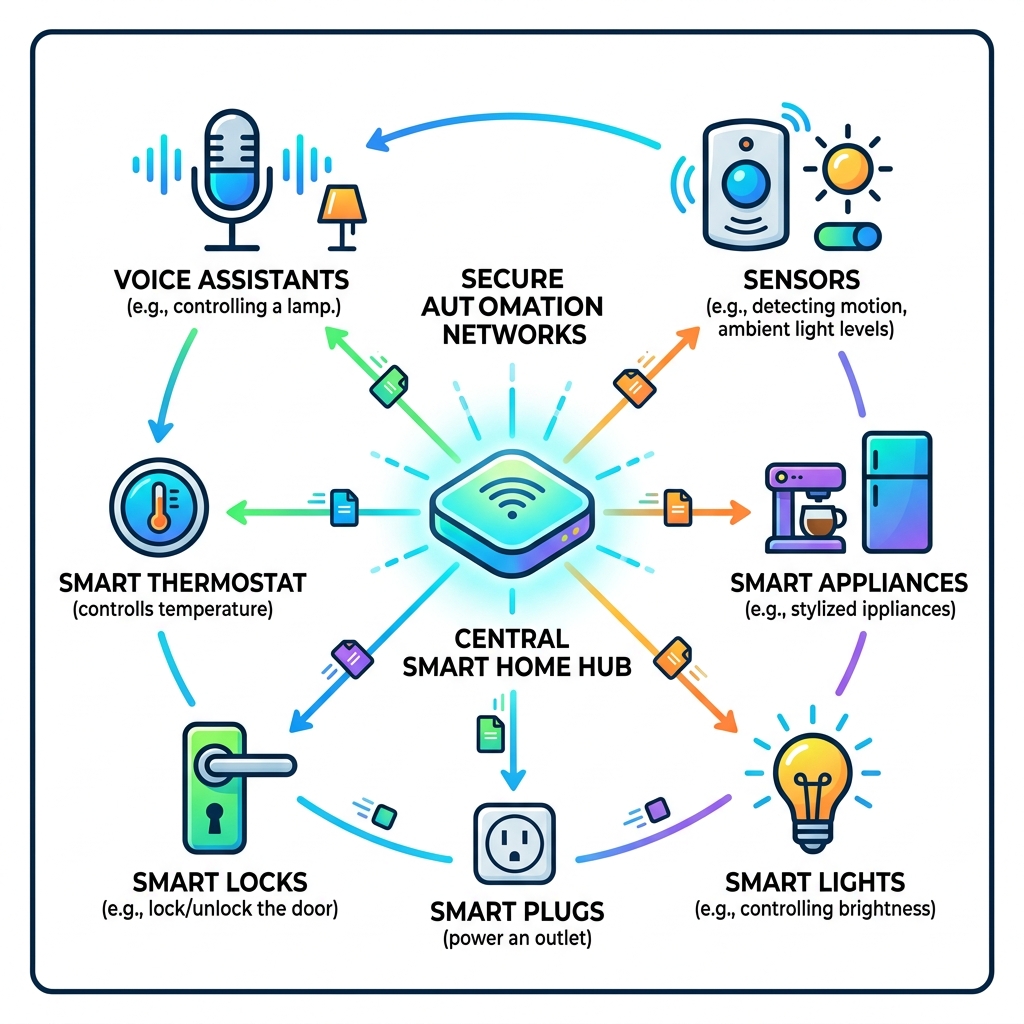
smart device automation ideas are ways to make your home’s gadgets work together automatically — so you don’t have to lift a finger.
Here are the most popular ones to start with:
- Lighting automations – Turn lights on at sunset, off when you leave, or dim them for movie time
- Smart plug schedules – Cut standby power from TVs and appliances automatically
- Thermostat routines – Adjust temperature when you arrive home or leave
- Smart lock automations – Auto-lock doors at bedtime or when everyone’s away
- Security routines – Arm cameras and alert you when motion is detected while you’re out
- Morning/night scenes – Trigger lights, coffee makers, and blinds with a single command
- Voice assistant routines – Control everything hands-free through Alexa, Google Assistant, or Siri
If you’ve ever walked out the door and wondered whether you left the lights on, or come home to a cold house in winter, you already understand the problem smart automation solves.
The numbers back this up. Around 69% of US households now own at least one smart device. And among those who use them well, 57% say they save around 30 minutes every day just from automated routines.
That’s not a small thing. Over a year, that’s roughly 182 hours back in your life.
Yet most people with smart devices use only a fraction of what they can do. A smart bulb gets turned on and off manually. A smart plug just sits there. The real power — the part that actually saves time and money — comes from automation.
47% of Millennials already own at least one smart home product, but setting up automations that actually work together still trips a lot of people up. Devices from different brands don’t always talk to each other. Apps feel complicated. And it’s hard to know where to start.
This guide cuts through all of that.
Getting Started with Smart Device Automation Ideas
Starting your smart home journey doesn’t require a degree in computer science. At its core, home automation is just a set of “If This, Then That” rules. If the sun goes down, then turn on the porch light. If the front door unlocks, then turn on the hallway lamp.
We recommend starting small. You don’t need to rewire your entire house. Most modern smart device automation ideas rely on simple Wi-Fi connected gadgets or “mesh” networks that strengthen themselves as you add more devices.
When choosing your first gadgets, you’ll likely encounter different “languages” or protocols. Wi-Fi is common but can get crowded if you have 50 bulbs. Zigbee and Z-Wave are lower-power alternatives that often require a hub to “talk” to your router. However, the industry has recently moved toward a much simpler solution that we think is a total game-changer for novices.
If you want a neutral overview of how these standards work, the Matter smart home standard is a useful reference before you buy your first devices.
More info about automation apps
The Role of Matter and Thread in Modern Setups
If you’ve spent any time researching smart homes, you’ve probably heard the horror stories of “ecosystem lock-in”-where a bulb works with Alexa but refuses to acknowledge Siri’s existence.
Matter is the new universal standard that fixes this. It allows devices from different brands to work together seamlessly across Apple Home, Google Home, and Amazon Alexa. When you see the Matter logo, you know that device will play nice with others.
Thread is the networking technology that often goes hand-in-hand with Matter. Think of it as a self-healing mesh network. Unlike Wi-Fi, where every device talks directly to your router, Thread devices talk to each other. If one bulb goes offline, the rest of the network stays strong. This results in reduced latency (no more waiting three seconds for a light to turn on) and better reliability.
Essential Devices for Smart Home Beginners
You don’t need a robot butler to have a smart home. We suggest starting with these four pillars:
- Smart Bulbs: The easiest way to change the “vibe” of a room and automate your evening.
- Smart Plugs: These are the “secret sauce” for novices. They turn any “dumb” appliance-like a coffee maker or a vintage lamp-into a smart one.
- Smart Speakers: Devices like the Amazon Echo or Google Nest Hub act as the “brain” and voice interface for your home.
- Motion Sensors: These are the “glue” that makes a home feel truly smart. They act as triggers so you don’t even have to use your voice.
Essential Lighting and Appliance Automations
Lighting is almost always the “gateway drug” for home automation. It’s visual, it’s immediate, and it solves real-world annoyances like fumbling for a switch in the dark.
One of our favorite smart device automation ideas is the “Sunset Trigger.” By using your home’s location, your smart app can automatically turn on your outdoor lights exactly when the sun goes down. No more adjusting timers as the seasons change!
Geofencing is another powerhouse. By using your phone’s GPS, your house can “sense” when you are half a mile away and turn on the entryway lights so you never walk into a dark house again.

Smart device automation ideas for lighting
Beyond just turning things on and off, smart lighting can improve your health and productivity.
- Circadian Rhythm: You can program your bulbs to mimic natural sunlight—bright, cool white during the day to keep you alert, and warm, amber tones in the evening to help your body prepare for sleep.
- Visual Alerts: For those who are hard of hearing (or just wear noise-canceling headphones), you can set your lights to flash red if the smoke detector goes off or pulse green when the laundry is done.
- Occupancy Sensing: Using motion sensors in hallways or bathrooms ensures lights are only on when someone is actually there. This is perfect for kids who always forget to “flip the switch.”
- RGBIC Gradients: Modern LED strips allow for multiple colors on one string. You can create a “movie mode” that casts a soft purple glow behind your TV, reducing eye strain and making your living room feel like a cinema.
For specific rooms like the kitchen, you can even set up “Scene Snapshots.” If you’ve manually dimmed the lights for a romantic dinner, a smart system can “remember” that state and restore it even after the motion sensor turns the lights off and back on again.
More info about simple routines
Transforming Everyday Appliances with Smart Plugs
Smart plugs are the unsung heroes of the smart home world. They are essentially a middleman between your wall outlet and your appliance.
One of the best smart device automation ideas for energy savings is tackling “phantom loads.” Many electronics, like TVs and game consoles, suck up power even when they are “off.” By using a smart plug schedule to cut power completely between midnight and 6:00 AM, homeowners often see a 5-10% reduction in their electricity bills.
You can also use them for convenience:
- Pre-warm a heated blanket 15 minutes before bedtime.
- Ensure the hair straightener or curling iron is definitely off after you leave the house.
- Create a “Clean Desk” routine where your monitors and desk lamps turn off automatically at the end of the workday, signaling your brain that it’s time to clock out.
More info about appliance automation
Climate Control and Energy Efficiency
If you want your smart home to pay for itself, focus on the thermostat. Nearly 33 million houses in North America already rely on smart thermostats, and for good reason.
Independent studies show that devices like the Nest Thermostat save an average of 10-12% on heating bills and 15% on cooling bills. In fact, 77% of potential homebuyers now say they want smart thermostats pre-installed when looking for a new home.
Practical Thermostat and Blind Automations
The real magic happens when you link your climate control to other sensors.
- HVAC Pausing: We’ve all been there—someone leaves a window open while the AC is blasting. By placing contact sensors on your windows, you can program your thermostat to pause automatically if a window stays open for more than five minutes.
- Smart Blinds: These aren’t just for showing off. You can set your blinds to close automatically during the hottest part of the day to keep the sun from baking your living room. This “thermal regulation” reduces the load on your AC significantly.
- Geofencing: Why heat or cool an empty house? Your thermostat can shift into “Eco Mode” the moment your phone leaves the driveway and start warming things up again when you’re five minutes away.
More info about energy routines
Advanced Sensors for Energy Management
Once you’ve mastered the basics, you can add specialized sensors to protect your home and wallet.
- Leak Detection: Placing a small water sensor under your kitchen sink or near the water heater can save you thousands in repairs. Some advanced setups can even trigger a smart valve to shut off the main water supply the second a leak is detected.
- Humidity Sensors: In the bathroom, a humidity sensor can automatically turn on the exhaust fan when it senses steam from a shower, preventing mold growth.
- Solar Integration: If you have solar panels, you can automate energy-hungry tasks—like running the dishwasher or charging your EV—to happen only when your panels are producing peak power.
More info about DIY automation
Security and Safety Routines
Peace of mind is arguably the most valuable thing a smart home provides. Whether it’s checking if the garage is closed or getting an alert that the kids made it home from school, security automations are a must-have.
Smart device automation ideas for home safety
Modern security isn’t just about loud sirens; it’s about proactive prevention.
- Auto-Locking: Set your smart lock to engage automatically after 30 seconds of the door being closed, or at a specific time every night (like 10:00 PM).
- Geofenced Garage: We’ve all had that “did I close the garage?” panic. You can set an automation to send you a notification—or close the door automatically—if you’ve driven more than a mile away and it’s still open.
- “Away Mode” Lighting: When you go on vacation, don’t just leave one light on. Use a routine that randomizes your lights throughout the house to simulate someone actually being home.
- Emergency Flashing: If your smart smoke or CO detector is triggered, you can program every smart bulb in the house to turn on at 100% brightness and flash red. This helps wake up heavy sleepers and lights the path to safety.
More info about assistant routines
Centralizing Control with Voice Assistants and IFTTT
While having twenty different apps on your phone is a nightmare, voice assistants like Alexa, Google Assistant, and Siri act as a central hub. They allow you to create “Scenes” that control multiple brands at once. A “Goodnight” command can lock the doors, turn off the lights, and set the alarm in one go.
For more complex smart device automation ideas, many pros use IFTTT (If This Then That). IFTTT acts as a bridge for devices that don’t normally talk to each other. For example, you could create an applet that says: “If my Ring doorbell senses motion, then log the time in a Google Spreadsheet and turn my office lamp blue.”
If you want to go even deeper, Z-Wave technology offers a highly secure, long-range wireless protocol that is excellent for security sensors and locks, as it operates on a different frequency than your crowded Wi-Fi.
More info about smart assistant routines
Frequently Asked Questions about Smart Home Setup
How much does it cost to start and expand a smart home?
You can start for as little as $20 with a single smart plug or bulb. A basic “starter kit” (a speaker, two bulbs, and a plug) usually costs under $100. Expanding a whole house can cost between $500 and $2,500 depending on how many “smart switches” and thermostats you install.
The good news? Many energy companies offer rebates of up to $100 for installing smart thermostats, and the energy savings often mean the devices pay for themselves within two years.
More info about appliance automation
What is the difference between a smart home and smart automation?
A “smart home” is simply a house with connected devices you can control from your phone. “Smart automation” is the next level—it’s when those devices act on their own based on conditional logic (time, weather, or sensor data) without you needing to open an app at all.
Do I need a hub for my smart device automation ideas?
In the past, yes. Today, it depends. Many Wi-Fi and Matter-over-Wi-Fi devices don’t need a hub. However, if you want local control (meaning your house stays smart even if the internet goes out) or you use Zigbee/Z-Wave devices, a hub like a Samsung SmartThings or a Home Assistant Green is a great investment.
Conclusion
At FinMoneyHub, we believe that technology should serve you, not the other way around. By implementing these smart device automation ideas, you aren’t just buying gadgets; you’re buying back your time and reducing your mental load.
Whether it’s the security of an auto-locking door or the simple joy of a coffee maker that starts the moment your morning alarm goes off, the possibilities are endless. Start small, focus on solving one daily friction point, and watch how quickly your home becomes a more responsive, intuitive place to live.
