
Gamify Your Bank Account with a Savings Goal Tracker
Why a Savings Goal Progress Tracker Changes How You Save
A savings goal progress tracker is one of the simplest tools you can use to turn a vague financial dream into a concrete, achievable plan. Here’s a quick overview of the best options covered in this guide:
| Tracker | Best For | Standout Feature |
|---|---|---|
| Loot App | Visual motivation | 3D money jar (4.8★, 8.2K ratings) |
| Savings Goal by RMY Studio | Simplicity | Thermometer progress bar (4.9★, 1M+ downloads) |
| ClearCheckbook | Multi-goal management | Percentage-based account allocation |
| Huntington Savings Goal Getter | Bank customers | Up to 10 goals + emergency fund per account |
| Investor.gov Calculator | Contribution planning | Government-backed compound interest tool |
Most people have a savings goal in mind — a vacation, a down payment, an emergency cushion. But without a system to track progress, those goals stay wishes.
The problem isn’t motivation. It’s visibility.
When you can’t see how close you are to the finish line, it’s easy to spend money that should be going toward your goal. A tracker fixes that by showing you exactly where you stand, how much you need to save each month, and how long it will take to get there.
The apps and tools in this roundup make saving feel less like a chore — and more like a game you’re winning.
What is a Savings Goal Progress Tracker?
At its core, a savings goal progress tracker is a financial compass. It is a digital or physical tool designed to help us calculate exactly how much we need to set aside and how long it will take to reach a specific financial target. Whether you are using a dedicated mobile app or a Savings Goal Tracker – Free Finance Tools, these instruments provide the structure needed to turn “I want to save money” into “I am 45% of the way to my $5,000 goal.”
Financial planning often feels abstract. We know we should save, but the daily grind makes it easy to lose sight of the big picture. By using a tracker, we move away from guesswork. These tools typically require a few simple inputs: your total goal amount, what you have saved already, and your desired timeframe. From there, the tracker provides visual indicators—like progress thermometers or charts—that give us an immediate “status check” on our financial health.
Using a tracker also encourages us to set SMART goals: Specific, Measurable, Achievable, Relevant, and Time-bound. Instead of a vague “travel fund,” a tracker helps us define a “$3,000 Tokyo Trip by December 2025.” This level of clarity is the foundation of successful wealth building.
Visualizing Your Savings Goal Progress Tracker
One of the most powerful aspects of modern tracking tools is the use of behavioral psychology. We are visual creatures; seeing a 3D jar fill with gold coins or a “charity-style” thermometer rising toward the top triggers a dopamine hit that manual spreadsheets simply can’t replicate.
Apps like Loot use 3D visualizations to make every dollar feel like a tangible addition to your “stash.” Others, like the Savings Goal app by RMY Studio, use percentage completion bars. These visual hacks serve as constant reminders of our progress. When we see that we are only $200 away from a milestone, we are much more likely to skip a frivolous purchase and put that money toward the goal instead. It turns the act of “not spending” into a rewarding game of “filling the jar.”
Common Financial Milestones to Track
What exactly should we be tracking? While everyone’s journey is different, most of us find success by categorizing our goals into short-term and long-term buckets:
- Emergency Funds: Financial advisors generally recommend keeping 3 to 6 months of living expenses (roughly $9,000 to $18,000 if your monthly expenses are $3,000) in a liquid account.
- Vacation Funds: Breaking down a $3,000 trip into a 12-month plan means saving just $250 a month.
- Down Payments: Saving for a home is a marathon. A $40,000 down payment over four years requires a disciplined $833 per month.
- Rainy Day/Sinking Funds: These are for irregular but predictable expenses, like car repairs, annual insurance premiums, or holiday gifts.
- Debt Payoff: Many users use trackers to visualize their journey toward being debt-free, treating the “zero balance” as the ultimate prize.

Essential Features for Financial Automation
When we look for the perfect savings goal progress tracker, we aren’t just looking for a pretty interface. We need functionality that reduces “financial friction.” The best tools integrate with our daily lives, much like how we use best energy-efficient smart gadgets to automate our home environment.
Key features to look for include:
- Push Notifications: Reminders to log a deposit or alerts when we hit a 25%, 50%, or 75% milestone.
- Round-up Features: Some tools link to your spending and “round up” every purchase to the nearest dollar, funneling the change into your goal.
- Security and Privacy: Since these tools handle sensitive financial data, look for 128-bit or 256-bit encryption. Many standalone calculators, like the one at Savings Goal Tracker – Free Calculator to Hit Any Goal, run locally in your browser, meaning they don’t even store your data on a server.
Choosing a Free vs. Premium Savings Goal Progress Tracker
Is it worth paying for a premium version? Most free trackers are incredibly robust, but premium upgrades (usually a small one-time fee like $2.99) often unlock:
- Unlimited Goals: Free versions might limit you to 1 or 3 goals at a time.
- Ad-Free Experience: No distractions while you’re focused on your finances.
- Multi-Device Sync: Ensuring your progress is visible on your phone, tablet, and desktop.
- Advanced Analytics: Detailed breakdowns of your saving habits and projected finish dates based on your current pace.
The Power of Automated Contributions
The “set it and forget it” mentality is the secret weapon of wealthy savers. By automating transfers to occur one or two days after payday, we remove the temptation to spend that money. This is often referred to as “paying yourself first.”
Automation turns saving from a monthly decision into a background process. Whether it is a direct transfer to a dedicated “Sinking Fund” or an AI-driven tool that scouts for extra change, reducing the number of manual steps we have to take significantly increases our chances of reaching the finish line.
The Math of Growth: Compounding and Contributions
To truly master your savings goal progress tracker, you have to understand the “engine” behind it: interest. Where you keep your money matters just as much as how much you put in.
| Account Type | Typical APY | Interest on $20,000 over 3 years |
|---|---|---|
| Traditional Savings | 0.01% | ~$6 |
| Standard “Brick & Mortar” | 0.50% | ~$300 |
| High-Yield Savings (HYSA) | 4.50% | ~$2,800 |
As you can see, choosing a High-Yield Savings Account (HYSA) can shave months off your timeline. A $20,000 goal starting with $5,000 and a $500 monthly contribution reaches the finish line roughly 3 months faster in an HYSA compared to a traditional bank account.
Calculating Your Monthly Savings Target
To find your “magic number,” you can use a Savings Goal Calculator – Monthly Savings Needed to Reach Your Financial Goal. The formula generally considers:
- Target Amount: The total cost of your goal.
- Current Savings: Your starting balance (which reduces the monthly burden).
- Timeframe: How many months you have to reach the goal.
- Expected APY: The interest rate of your account.
For example, if you want to save $10,000 in 3 years at a 4% interest rate, you would need to contribute approximately $262 per month. Without interest, that number jumps to $278. Over time, that “interest gap” grows significantly.
How Compounding Accelerates Your Timeline
Compound interest is the process where you earn interest on your initial principal plus the interest that has already accumulated. Most savings accounts compound monthly. This means that every month, your “progress” isn’t just coming from your pocket—it’s coming from the bank’s pocket, too.
Trackers that include compound interest in their projections, such as the Interactive Savings Goal Calculator – Plan Your Target, allow you to see a “Growth Chart.” This visualization shows the curve of your balance getting steeper over time as interest does more of the heavy lifting.
Digital Apps vs. Bank-Integrated Tools
There are two main ways to track your progress: using a standalone app or using the tools built directly into your banking interface. Both have unique advantages. We often compare this to choosing between specialized smart devices or an all-in-one hub, much like the strategies we discuss in our smart assistant energy-saving tips.
Standalone Tracker Mechanics
Standalone apps like Loot or Savings Goal (RMY Studio) are fantastic for those who want a dedicated space for their dreams.
- Pros: Highly customizable, often feature gamified elements (like 3D jars), and allow you to track goals that might be spread across different banks.
- Cons: Require manual entry of deposits unless they offer “Plaid” integration to link your accounts.
These apps are great for “mental accounting.” By seeing a custom image of a beach in Maui every time you open the app, you reinforce the emotional connection to your goal.
Bank-Integrated Advantages
Many modern banks now offer “Buckets” or “Goal Getters” within their official mobile apps. For instance, some banks allow you to create up to 10 sub-savings goals plus an emergency fund within a single account.
- Pros: Real-time accuracy, seamless transfers, and “AI Scouts” that automatically move money when they detect you have a surplus.
- Cons: Often less “fun” or visual than standalone apps, and you are tied to that specific bank’s ecosystem.
The biggest advantage here is the lack of manual work. When you spend $3.50 on a coffee, the bank’s integrated tracker can automatically move $0.50 into your “New Car” goal without you lifting a finger.
Strategies to Stay Motivated and On Track
Setting the goal is the easy part; sticking to it for 12 or 48 months is the challenge. To ensure success, we recommend a few “pro-saver” strategies:
- The 10% Buffer: When setting a target date, add a 10% time buffer. If you think you can save for a car in 20 months, plan for 22. This accounts for the months where “life happens”—car repairs, unexpected vet bills, or a missed contribution.
- Weekly Check-ins: Spend five minutes every Sunday reviewing your savings goal progress tracker. This keeps the goal top-of-mind for the coming week.
- Public Commitment (or a Savings Buddy): Telling a friend about your goal creates a layer of accountability.
- Smart Sensors for Finances: Just as you might be using smart sensors for energy efficiency to monitor your home, use alerts in your tracking app to monitor your spending “leaks.”
Adjusting Goals When Falling Behind
If you miss a month or have an emergency that drains your progress, don’t panic. Consistency beats perfection. Most trackers allow you to “re-balance.” By updating your “Current Saved” amount, the tool will simply recalculate your monthly needs. You might find that adding just $15 to your monthly contribution or extending your deadline by two months puts you right back in the driver’s seat.
Look for “found money” to give yourself a boost. Did you get a tax refund? A birthday gift? A small bonus at work? Instead of letting it disappear into your checking account, “boost” your goal. Even a one-time $100 injection can shave weeks off a long-term timeline.
Psychological Benefits of Visual Progress
Why does seeing a bar turn from red to green matter? It’s about “Loss Framing” and “Commitment Devices.” When we see a progress bar at 80%, we feel a psychological “loss” if we don’t complete the remaining 20%. Our brains want to close the loop.
This visual clarity reduces the mental load of financial management. Instead of worrying about whether you can afford a dinner out, you can check your tracker. If your “Vacation Goal” is on track for the month, you can spend with confidence and zero guilt.
Frequently Asked Questions about Savings Trackers
How much should I save monthly based on my income?
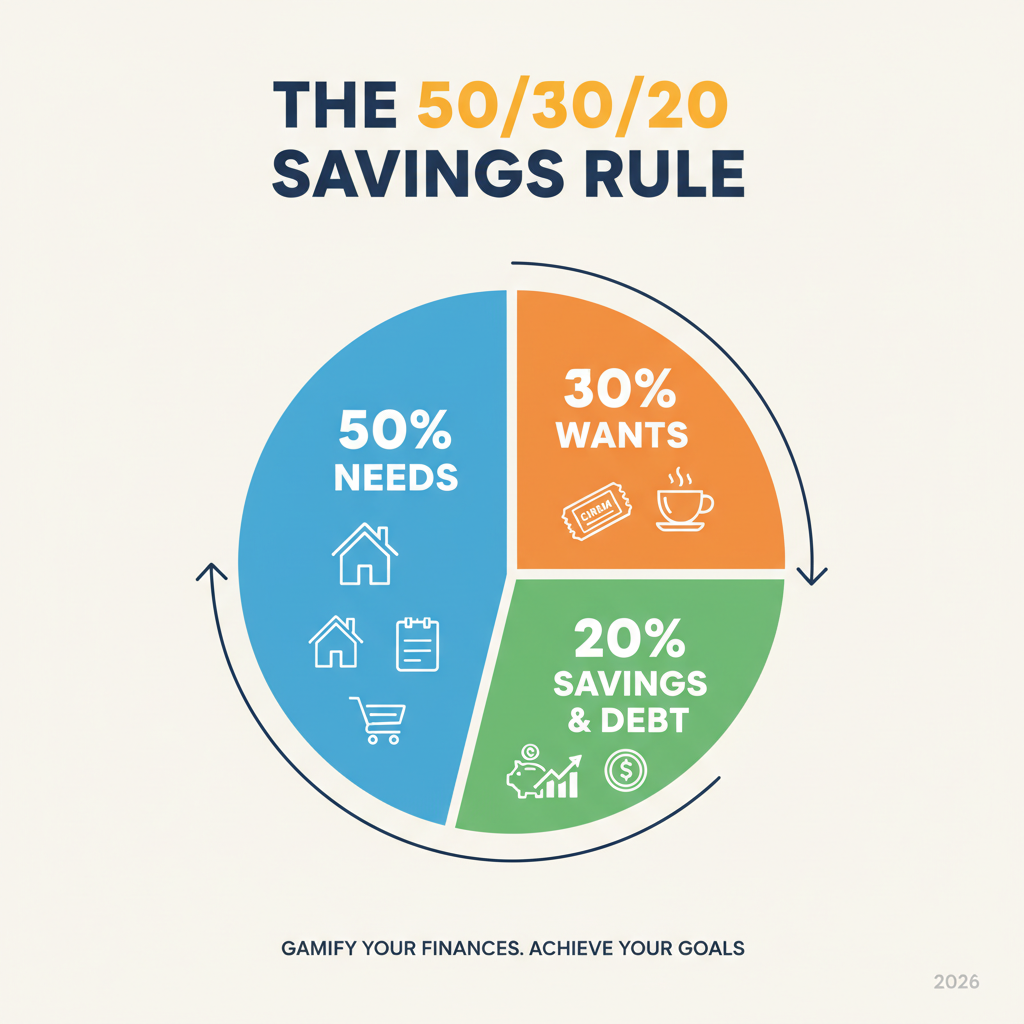
While everyone’s situation is unique, the 50/30/20 rule is a gold standard. This suggests allocating 50% of your take-home pay to “Needs” (rent, groceries), 30% to “Wants,” and 20% to Savings and Debt Repayment.
If you take home $5,000 a month, a standard savings goal would be $1,000. If you are being aggressive, you might aim for 30-40% ($1,500-$2,000). If you are just starting out, even 5-10% is a great way to build the habit. You can use a Savings Goal Tracker – How Much to Save Each Month | UseACalculator.com to see how these different percentages affect your timeline.
What is the recommended size for an emergency fund?
Most financial experts suggest a safety net of 3 to 6 months of essential living expenses. If your “must-pay” bills total $3,000 a month, your goal should be $9,000 to $18,000. This fund should be kept in a separate, liquid high-yield savings account so it’s accessible but not “tempting” for daily spending.
How do different interest rates impact my goal timeline?
The difference is staggering. On a $30,000 goal, saving $500 a month at a 0% interest rate takes 60 months. At a 4% interest rate, the interest itself contributes nearly $3,000 toward your goal, allowing you to reach the target several months earlier. Always look for the highest APY possible for your short-to-medium-term goals.
Conclusion
Achieving financial freedom doesn’t require a massive salary; it requires a smart system. By using a savings goal progress tracker, you take control of your financial narrative. You move from being a passive observer of your bank balance to an active architect of your future.
Whether you prefer the gamified 3D jars of a standalone app or the automated “scouts” of a bank-integrated tool, the key is to start today. Define your goal, set your timeline, and let the visual progress motivate you to cross the finish line.
At FinMoneyHub, we believe in using technology to simplify the complex. From setting up digital routines to mastering your savings, the right tools make all the difference. Start tracking, start saving, and watch your dreams turn into reality, one percentage point at a time.
