
Fintech App Voice Integration and the Future of Banking
The Strategic Value of Fintech App Voice Integration
The shift toward fintech app voice integration isn’t just about following a trend; it’s a strategic move to meet rising consumer expectations. Today, customers don’t just want digital tools—they want those tools to be instant, secure, and available exactly when they need them. By moving beyond traditional “point and click” interfaces, financial institutions can create a more natural, conversational relationship with their users.

The primary value lies in 24/7 availability. Human call centers are expensive to staff around the clock, and wait times during peak hours lead to customer frustration. Voice AI agents, however, never sleep and don’t get tired. They can handle thousands of concurrent inquiries with the same level of precision and “perfect memory” of a user’s previous interactions. This level of service allows companies to unlock AI’s potential in banking by transforming reactive support into proactive engagement.
Enhancing Accessibility through Fintech App Voice Integration
One of the most heartwarming and practical benefits of voice technology is its impact on financial inclusion. For users with visual impairments or mobility challenges, navigating a complex mobile UI with small buttons and multi-step menus can be a significant barrier.
Voice integration turns the smartphone into an accessible gateway. Instead of struggling to find the “Transfer” button, a user can simply say, “Send fifty dollars to my sister for dinner.” This aligns with Web Content Accessibility Guidelines (WCAG) and broader inclusive banking initiatives. If you are just starting out with voice tech at home, you might find our more info about smart speaker setup helpful for understanding how these devices bridge the gap between users and their digital lives.
Operational Efficiency and Cost Savings
From a business perspective, the numbers are hard to ignore. Labor represents the single largest operational expense in financial contact centers. Research suggests that fintechs can reduce their operational overhead by 30% to 70% by implementing voice AI.
Consider that the financial services sector accounts for over $100 billion in annual business process outsourcing (BPO) spend. By automating routine “primitives”—like balance checks, password resets, and transaction history—institutions can reallocate their human talent to high-empathy, complex negotiations that actually require a human touch.
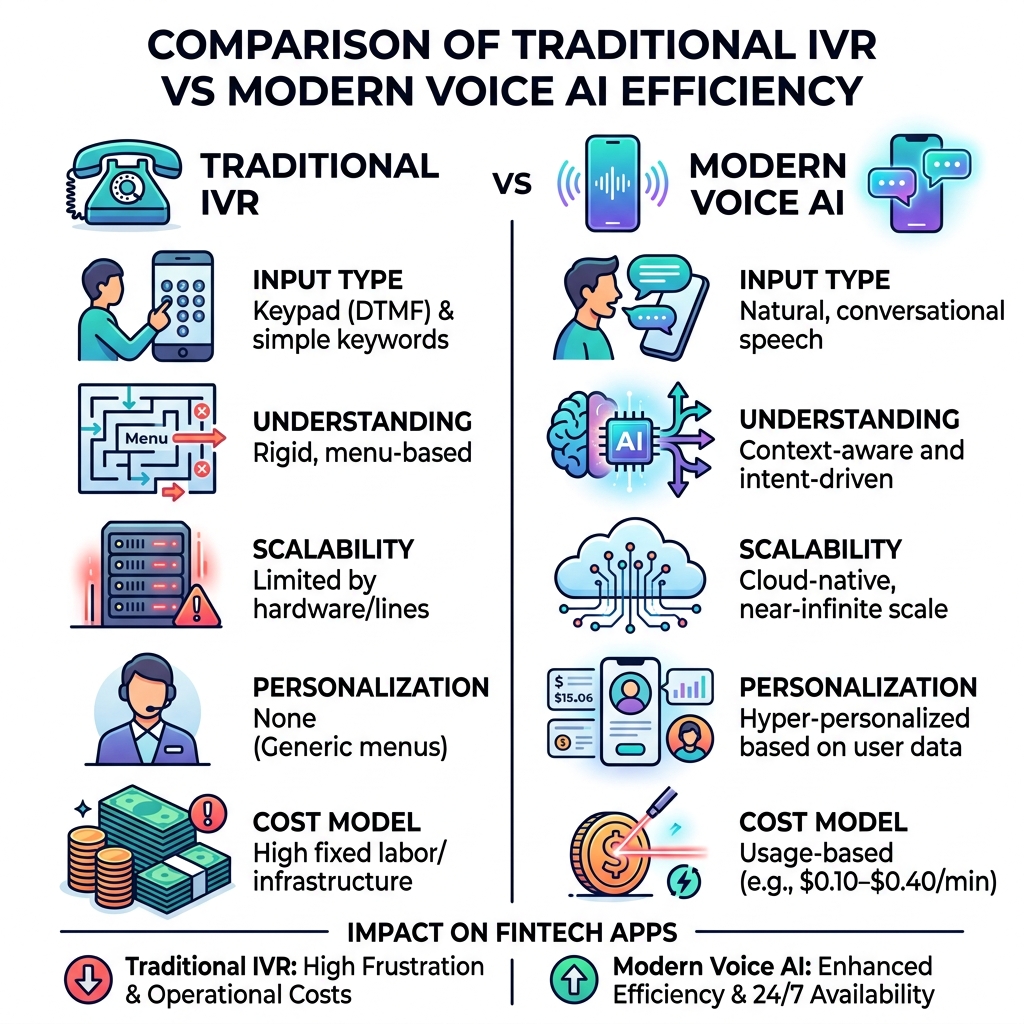
| Feature | Traditional IVR | Modern Voice AI |
|---|---|---|
| Input Type | Keypad (DTMF) or simple keywords | Natural, conversational speech |
| Understanding | Rigid, menu-based | Context-aware and intent-driven |
| Scalability | Limited by hardware/lines | Cloud-native, near-infinite scale |
| Personalization | None (Generic menus) | Hyper-personalized based on user data |
| Cost Model | High fixed labor/infrastructure | Usage-based (e.g., $0.10–$0.40/min) |
Core Technologies Powering Voice AI in Finance
To understand how fintech app voice integration works, we have to peek under the hood at the “neural network” of technologies that make it possible. It isn’t just a single piece of software; it’s an orchestration of several advanced AI disciplines.

At the foundation is Automatic Speech Recognition (ASR), which converts the acoustic waves of your voice into text. Next, Natural Language Understanding (NLU) analyzes that text to figure out what you actually mean. Finally, Text-to-Speech (TTS) converts the machine’s response back into a natural-sounding human voice. For those building in this space, platforms like those offered for the voice AI for finance industry provide the low-latency infrastructure needed to make these interactions feel instantaneous.
Natural Language Processing (NLP) and ASR
Modern NLP has evolved far beyond simple keyword matching. Today’s models, powered by Large Language Models (LLMs) like Llama or Claude, can understand context, tone, and even sentiment.
For example, if a customer says, “I can’t believe my card was declined again!” the AI can detect the frustration (sentiment analysis) and prioritize the call or adjust its tone to be more empathetic. Furthermore, multilingual support is now a standard requirement. An immigrant worker could query their auto loan details in their native Tagalog on a Sunday afternoon without needing a human translator present. For those new to the tech, we’ve put together some beginner-friendly voice assistant tips to help you get comfortable with how these systems process language.
Voice Biometrics and Identity Verification
Security is the “currency” of fintech. Traditional authentication—like remembering your mother’s maiden name or a 16-digit card number—is prone to friction and fraud. Enter voice biometrics.
Every person has a unique “voiceprint” determined by the physical shape of their vocal tract and their speaking patterns. Voice AI can use this voiceprint to verify a user’s identity with high precision, often replacing the need for passwords entirely. This creates a “hands-free” secure environment. We often discuss these types of advanced features in our guide on more info about smart assistant routines, as they represent the gold standard for secure, automated interactions.
Key Use Cases for Voice-Enabled Banking
The true power of fintech app voice integration shines when it moves from “answering questions” to “executing tasks.” We are moving toward “agentic” models—AI that has the authority to actually move money and update records.
Whether it’s FinTech AI Voice Assistant Development for custom banking workflows or off-the-shelf solutions for smaller apps, the use cases are expanding rapidly into high-stakes financial territory.
Real-Time Fraud Detection and Alerts
Fraud is a $10 billion problem (as of 2023 data). When a suspicious transaction occurs, every second counts. SMS alerts are often ignored, and emails get buried in spam.
Voice AI can trigger an instant, automated callback the moment a fraud engine flags a transaction. The AI identifies itself, verifies the user via voice biometrics, and asks: “Did you just authorize a $1,200 purchase in Miami?” If the answer is no, the AI can block the card and initiate a dispute case in under 60 seconds. This proactive approach saves money and builds immense customer trust. It’s even more efficient than more info about smart assistant energy saving—it’s about saving your hard-earned capital.
Transaction Execution and Account Management
Beyond emergencies, voice integration simplifies daily banking. Users can perform a wide range of tasks without ever opening a menu:
- Balance Inquiries: “Hey, how much do I have left in my vacation fund?”
- Fund Transfers: “Move $200 from checking to savings.”
- Bill Payments: “Pay my electric bill scheduled for tomorrow.”
- Loan Status: “What’s the payoff balance on my auto loan?”
By integrating AI voice solutions for banking & fintech, companies can provide these services across mobile apps, web portals, and even physical kiosks or ATMs.
Overcoming Implementation Challenges and Security
While the benefits are clear, integrating voice into a regulated financial environment isn’t without its hurdles. You can’t just “plug in” a basic chatbot and hope for the best.
Fintech companies must navigate legacy system compatibility and stringent data privacy laws. Even when looking for more info about affordable smart assistants, the underlying security must be “bank-grade.”
Technical Requirements for Fintech App Voice Integration
To build a successful voice agent, you need a robust tech stack. This typically involves:
- SDK Integration: A lightweight Software Development Kit that sits inside your mobile app.
- API Connectors: Secure bridges that allow the AI to “talk” to your core banking system or CRM.
- RAG (Retrieval-Augmented Generation): This ensures the AI pulls answers from your specific, approved documents (like fee schedules) rather than “hallucinating” or making things up.
- Low-Latency Infrastructure: To avoid the awkward “robotic” pauses, the round-trip time for a voice request should ideally be under 200 milliseconds.
Compliance with GDPR and PCI DSS
In finance, data is sacred. Voice recordings containing PII (Personally Identifiable Information) must be handled with extreme care.
- PCI DSS: If a user speaks their credit card number, the system must use “DTMF masking” or immediate redaction to ensure that the sensitive data isn’t stored in logs.
- GDPR/SOC 2: Systems must be auditable, with clear trails of who accessed what data and when.
- Encryption: All voice data must be encrypted both in transit and at rest.
Leading platforms now offer “air-gapped” or on-premise deployment options, allowing banks to keep all voice processing within their own secure firewalls.
The Future of Voice AI in Financial Services
What’s next for the “voice-first” bank? We are entering the era of Generative Intelligence and Emotional Awareness.
Imagine a voice assistant that doesn’t just tell you your balance, but notices your spending habits have changed. It might say, “I see you’ve spent 20% more on dining out this month. Would you like me to adjust your budget or move some funds to cover your upcoming rent?”
This transition from reactive support to “autopilot finance” will see AI acting as a proactive financial advisor. As we look toward the best smart home assistants 2026, we expect these financial agents to integrate seamlessly into our homes, helping us manage our wealth through simple, natural conversation while we cook dinner or drive to work.
Frequently Asked Questions about Voice Banking
Is voice banking secure for high-value transactions?
Yes, provided it uses multi-layer authentication. Most enterprise-grade fintech apps combine voice biometrics with “step-up” authentication—like a PIN or a push notification to a registered device—before allowing high-value transfers.
How does voice AI differ from traditional phone menus?
Traditional menus (IVR) are rigid: “Press 1 for balance.” If you have a complex question, they fail. Voice AI uses NLP to understand intent, allowing you to speak naturally: “I think I lost my card at the grocery store, can you help?”
Can voice assistants handle complex financial advice?
Currently, they excel at data retrieval and task execution. However, with the integration of RAG and LLMs, they are increasingly capable of providing “predictive guidance” based on your specific financial history and institutional policies.
Conclusion
At FinMoneyHub, we believe that the future of technology is invisible. You shouldn’t have to learn how to use a bank’s complicated app; the bank’s app should learn how to speak to you.
Fintech app voice integration is the bridge to that future. By mastering smart assistant routines and leveraging complex command capabilities, financial institutions can lower their costs while providing a level of service that feels truly human. Whether it’s protecting your account from a 3 AM fraud attempt or simply helping you save for your next home, voice AI is turning the “cold” world of finance into a warm, conversational experience.
Ready to see how smart tech can simplify your financial life? Explore FinMoneyHub resources today and discover the latest in smart assistant routines and digital device mastery.
