
Evening Automation Schedule Ideas for a Smarter Sunset
Why Evening Automation Schedule Ideas Are Worth Setting Up Tonight
Evening automation schedule ideas are one of the easiest ways to make your smart home actually work for you — not the other way around.
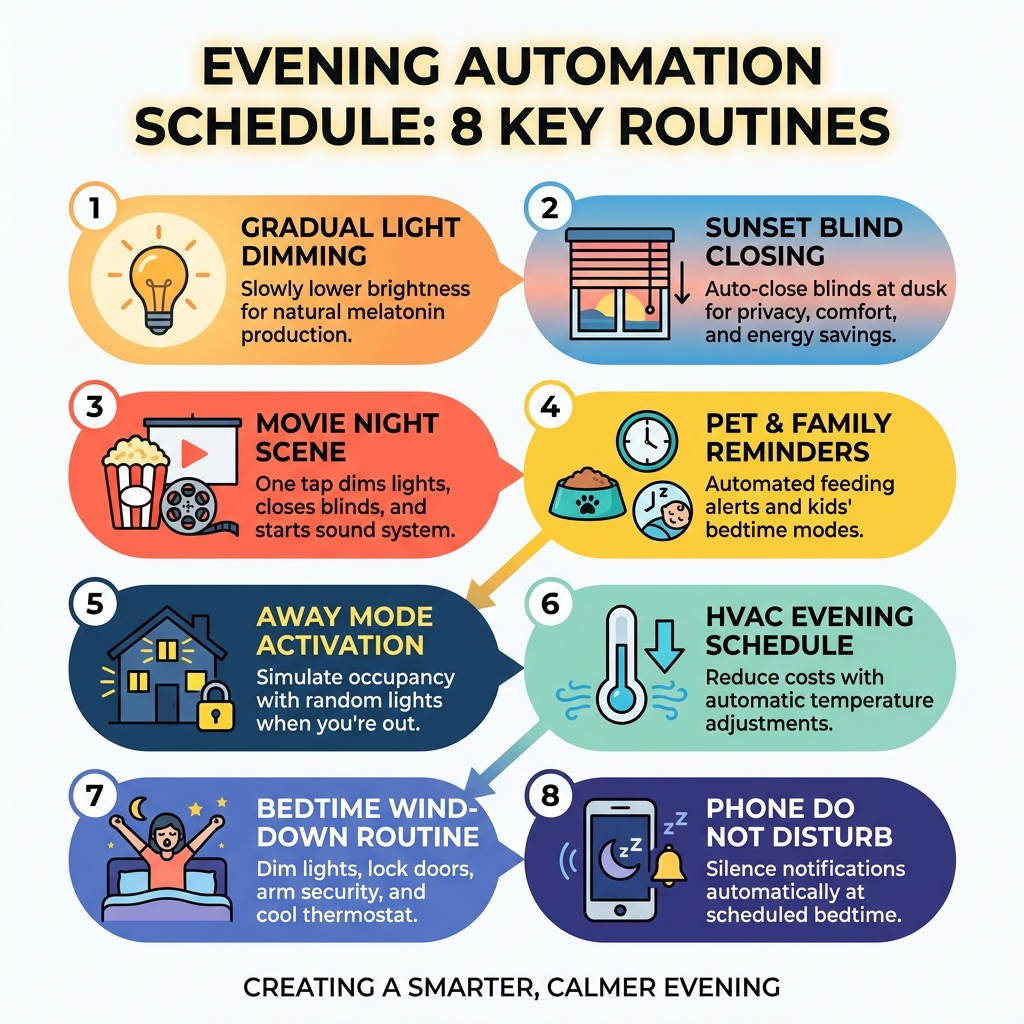
Here are the most popular evening automations to get started with:
- Gradual light dimming – Slowly lower brightness over 30 minutes before bed to help your body produce melatonin naturally
- Sunset blind closing – Auto-close blinds at dusk for privacy, comfort, and energy savings
- Bedtime wind-down routine – Dim lights, lock doors, arm security, and cool the thermostat to 65-68°F all at once
- Movie night scene – One tap dims lights, closes blinds, and starts your sound system
- Away mode activation – Simulate occupancy with random lights when you’re out
- Phone Do Not Disturb – Silence notifications automatically at your scheduled bedtime
- Pet and family reminders – Automated dinner bells, feeding alerts, and kids’ bedtime modes
- HVAC evening schedule – Reduce heating and cooling costs by 10-15% with automatic temperature adjustments
Most people manage their smart devices one by one — turning off lights here, checking the thermostat there, remembering to lock the door. It adds up to a surprising amount of mental load every single evening.
The good news? A few well-placed automations can handle all of it for you. Smart home automation works on simple logic: if X happens, do Y. Sunset triggers blinds. A set time dims the lists. Your bedtime arms the alarm.
You don’t need a complicated setup to start. Even one or two automations can completely change how your evenings feel — calmer, more consistent, and a lot less hands-on.
The Benefits of Evening Automation Schedule Ideas
When we think about smart homes, we often focus on the “cool” factor—voice-controlled gadgets or futuristic screens. However, the real magic of implementing evening automation schedule ideas lies in the subtle ways they improve our health, safety, and bank accounts.
One of the most significant benefits is the reduction of “decision fatigue.” By the time the sun sets, most of us have made thousands of small choices. Automating your home’s transition into night mode means you don’t have to remember to lock the front door or turn down the heat. It just happens.
Beyond convenience, these routines offer:
- Biological Alignment: Our bodies are wired to respond to light. Gradual dimming mimics a natural sunset, which triggers melatonin production and prepares your brain for deep sleep.
- Energy Efficiency: Statistics show that an automatic away mode or a scheduled evening thermostat adjustment can reduce heating and cooling costs by 10-15%.
- Enhanced Security: Automations can simulate your presence by toggling lights randomly while you’re at dinner, or ensure the garage door is never left open after dark.
- Stress Reduction: Walking into a pre-lit, climate-controlled home removes the friction of manual chores, allowing you to focus on family or relaxation.
If you are just beginning your journey into a more connected home, we recommend checking out our guide on smart home scheduling for beginners to build a solid foundation.

Smart Lighting and Ambiance for a Relaxing Night
Lighting is the cornerstone of any evening routine. It sets the mood, signals the end of the workday, and helps your eyes rest after hours of staring at blue-light-emitting screens. For a truly relaxing atmosphere, we suggest focusing on color temperature.
In the evening, you should aim for “warm” light – specifically around 2700K or lower. This amber hue is much closer to candlelight or a sunset than the harsh “daylight” bulbs often found in offices. If you don’t have smart bulbs yet, smart plugs are a fantastic alternative; they allow you to automate standard floor lamps to turn on exactly when the sun goes down. To dive deeper into the basics, see our article on understanding smart light scheduling for beginners.
Implementing Evening Automation Schedule Ideas for Better Sleep
Sleep science tells us that a sudden shift from bright light to total darkness isn’t ideal for our circadian rhythms. Instead, we can use evening automation schedule ideas to create a “sunset simulation.”
- The 30-Minute Fade: Set your bedroom lights to begin dimming 30 minutes before your target sleep time. Start at 100% and drop by about 3% every minute. This gradual transition mimics nature and nudges your brain toward sleep.
- Blue Light Reduction: Many smart lighting systems can automatically shift from cool whites to warm oranges as the evening progresses, minimizing the blue light that keeps us awake.
- The “Night Mode” Shift: At a specific time (say, 10:00 PM), all non-essential lights in the house should turn off, while hallway lights dim to 10% to act as motion-activated nightlights.
This concept also works in reverse. Just as a sunset simulation helps you fall asleep, gradual wake-up lighting (sunrise simulation) can help you wake up refreshed by slowly increasing brightness before your alarm goes off.
Creating the Perfect Movie Night and Entertainment Scene
Sometimes, the evening isn’t about sleeping – it’s about entertainment. A “Movie Night” scene is a classic example of how complex commands can make life feel luxurious. With one voice command or a tap on your phone, you can trigger a chain reaction:
- Smart Blinds: Close the automatic blinds at sunset to eliminate glare on the screen.
- TV Sync: Power on the television and the surround sound system.
- Ambiance: Dim the overhead lights to 10% and turn on a soft LED strip behind the TV to reduce eye strain.
Using easy smart assistant routines allows you to group these actions into a single “Showtime” trigger, so you can spend less time fiddling with remotes and more time with the popcorn.
Enhancing Home Security and Energy Efficiency
A smart home is a safe home. When the sun goes down, your evening automation schedule ideas should shift to protection. This includes “presence simulation” – a clever way to make it look like someone is home even when the house is empty. By randomizing light schedules in different rooms, you can deter potential intruders far more effectively than a single porch light ever could.
Geofencing is another powerful tool. Your home can detect when your smartphone enters a specific radius, automatically unlocking the door and disarming the security system as you pull into the driveway. For more on this, check out our simple security automation ideas for your smart home.
Maximizing Savings with Evening Automation Schedule Ideas
Efficiency and comfort go hand-in-hand. One of the best ways to save money is to optimize your HVAC system for the evening.
- Sleep Temperatures: Experts agree that a cooler room promotes better sleep quality. We recommend automating your thermostat to drop to 65-68°F (18-20°C) about an hour before bed.
- Passive Solar Control: By automating blinds to close at sunset, you trap heat inside during the winter and keep the cool air in during the summer, reducing the load on your heater or AC.
- Peak Hour Management: In many areas, electricity is more expensive during early evening hours. You can schedule heavy appliances like dishwashers to run only after 9:00 PM to take advantage of lower rates.
For those looking to streamline their daily tasks, our simple home automation routines guide offers excellent tips on managing energy without lifting a finger.
Automated Pet Care and Family Coordination
Evening routines aren’t just for the grown-ups; they can help manage the whole “pack.”
- Pet Care: If you have a busy schedule, an automated fish feeder can ensure your aquatic friends are fed at the same time every night. You can even set up a notification to remind you when the food levels are getting low.
- The Dinner Bell: Use your smart speakers to broadcast a “Dinner is ready!” announcement across the house, saving you from shouting up the stairs.
- Kids’ Bedtime Modes: You can create a specific routine for the little ones that starts with a “wind-down” announcement, followed by their favorite bedtime playlist and a slow dimming of their bedroom lights.
Integrating these simple home automation routines ensures that the evening transition is smooth for every family member, including the four-legged ones.
Building a Gentle Bedtime Wind-Down Routine
The transition from “active evening” to “sleep mode” is where automation truly shines. A 30-minute wind-down routine helps signal to your brain that the day is over.
We suggest setting a trigger for 9:30 PM (or whenever suits your schedule) to begin the “Evening Handoff.” This routine might include:
- Silencing the World: Automatically enabling “Do Not Disturb” (DND) mode on your phone to prevent late-night pings from interrupting your peace.
- The Final Check: A voice announcement that confirms the front door is locked and the garage is closed.
- The Sleep Prep: Lowering the thermostat and turning off all lights except for a dim path to the bathroom.
By using the best routines for smart assistants, you can ensure that your home “tucks you in,” allowing you to drift off without a care.
Essential Tools and Troubleshooting for Evening Routines
To make these evening automation schedule ideas a reality, you need the right backbone. While Wi-Fi is the most common connection, many professional-grade sensors use Zigbee or Thread for better reliability and lower battery drain.
| Protocol | Range | Best For | Compatibility |
|---|---|---|---|
| Zigbee | Medium | Sensors & Bulbs | Requires a Hub |
| Thread | Medium | Fast response | Matter-ready |
| Matter | Varies | Universal control | High (Cross-brand) |
| Wi-Fi | Long | High-bandwidth (Cameras) | No Hub needed |
Pro-Tips for Success:
- Wi-Fi Stability: Place your router centrally or use extenders to ensure your bedroom devices don’t go offline.
- Manual Overrides: Always ensure you have a physical way to turn off a light or open a door. Technology should assist, not trap.
- Battery Management: Set a monthly reminder to check the batteries in your smart locks and blinds. Most apps will give you a “low battery” alert at 20%.
If you run into issues, such as lights “jumping” in brightness instead of dimming smoothly, check our beginner-friendly assistant automation tips for troubleshooting advice. You can also explore various smart home automation apps for beginners to find the interface that feels most intuitive for you.
Frequently Asked Questions about Evening Automations
How can I ensure my evening automations are flexible for guests?
The best way to handle guests is to create a “Guest Mode” toggle. When active, this condition can pause your usual bedtime dimming or prevent the security system from arming while people are still moving around the living room. You can also use physical smart buttons that guests can press to override the schedule.
What are the most common issues when setting up night modes?
The most common issue is “false triggers” – for example, the lights turning off while you’re still in the middle of a late-night movie. To fix this, add conditions to your automation, such as “Only turn off lights if the TV is also off” or “Wait for 15 minutes of no motion.”
Which devices are essential for a beginner’s evening schedule?
You don’t need everything at once! Start with a smart hub (like a popular smart speaker or hub), a few smart bulbs for the bedroom, and a smart plug for a living room lamp. These three items allow you to test almost all the routines mentioned in this article.
Conclusion
At FinMoneyHub, we believe that technology should serve your lifestyle, not complicate it. By implementing these evening automation schedule ideas, you aren’t just buying gadgets—you’re buying back your time and peace of mind.
Whether it’s the 30-minute dimming that helps you sleep better or the automated security that keeps your family safe, smart tech integration is about creating a home that understands your needs. Our expertise in complex command capabilities means we can help you move beyond simple “on/off” switches to a truly intelligent, responsive environment.
Take the first step toward smarter living with FinMoneyHub and transform your sunset from a series of chores into a seamless, relaxing experience.
