
Easy Assistant Budget Setup for the Financially Savvy Techie
Why an Easy Assistant Budget Setup Is the Smartest Move You Can Make Right Now
An easy assistant budget setup is the process of configuring digital or smart home assistants — like Amazon Alexa, Google Home, or open-source platforms such as Home Assistant — to automate your devices and help you track and manage your finances, all without spending a fortune.
Here’s what you can achieve quickly:
- Control appliances via voice commands or smartphone apps
- Automate schedules for lights, thermostats, and plugs
- Track spending using AI-powered budget tools or free calculators
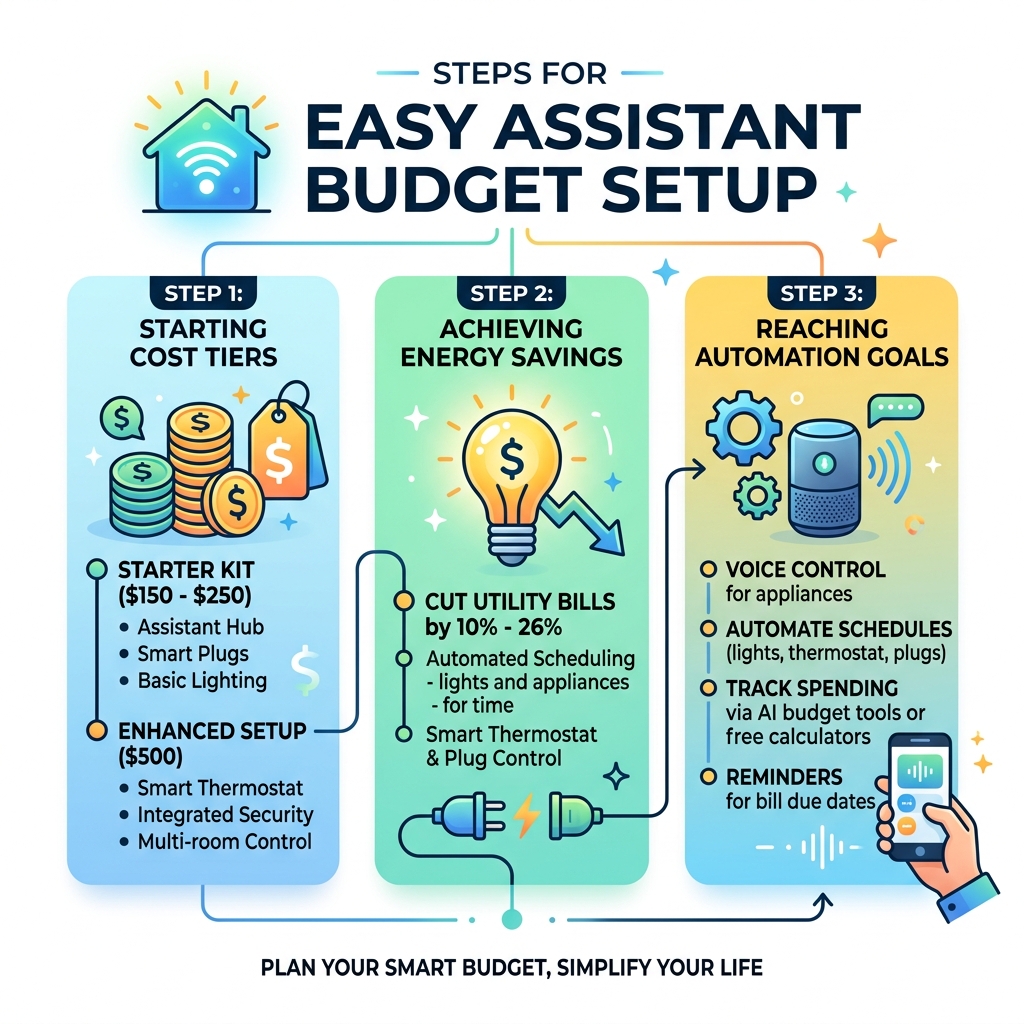
- Cut energy bills by 10–26% with smart thermostat and plug automation
- Get started for as little as $150, scaling up to a comprehensive $500 setup
Managing your smart home and your finances used to mean two completely separate systems. Today, the line between them is blurring fast.
Think about it: your voice assistant can already set timers, play music, and lock your doors. With the right setup, it can also remind you of bill due dates, help you stick to a budget category, and automate the energy-draining devices that quietly inflate your utility bills.
The smart home market is heading toward 77.6% household penetration by 2026. That means most people will have some form of assistant-driven automation in their home — but not all of them will have set it up smartly.
This guide is for the ones who want to do both: automate their home and their finances, without wasting money in the process.
The Fundamentals of an Easy Assistant Budget Setup
When we talk about an easy assistant budget setup, we are looking at the intersection of smart home automation and disciplined financial management. The smart home market is no longer a playground for the ultra-wealthy. With an average revenue per installed smart home sitting around $62.46, companies are making devices more accessible than ever.
To build a setup that actually serves your wallet, we need to understand the tiers of automation. You can create a comprehensive smart home for approximately $150 to $500. At the lower end ($150–$250), you get a solid starter kit: a voice assistant, a few smart plugs, and basic lighting. At the $500 mark, you’re looking at integrated security, smart thermostats, and multi-room control.
The principles of effective budget building apply here just as much as they do to your bank account. We recommend a “Plan Your Pay” style approach:
- 60% for Essentials: Your core hub, primary lighting, and security.
- 30% for Nice-to-Haves: Multi-room audio or advanced sensors.
- 10% for Near-term Goals: Saving up for that high-end smart appliance.
By integrating these devices with smart assistant routines, you create a home that works for you. For more depth on the basics, check out our guide on the first steps to mastering smart home assistants.
Prioritizing Hardware and Repurposing Old Tech
The biggest mistake people make is buying everything brand new. If you want an easy assistant budget setup, you should look at what you already own. A smart home doesn’t require a supercomputer; it requires a brain.
Essential Devices to Prioritize:
- The Hub/Assistant: This is your Amazon Echo, Google Nest, or a DIY Home Assistant server.
- Smart Plugs: These are the “Swiss Army Knives” of automation. At $10–$25, they turn “dumb” appliances (like coffee makers or lamps) into smart ones.
- Smart Lighting: Start with high-traffic areas.
- Smart Thermostats: These offer the highest ROI, often paying for themselves in energy savings within a year.
For those just starting, we’ve compiled smart speaker setup for beginners to help you choose the right “voice” for your home.
Hardware Hacks for an Easy Assistant Budget Setup
If you’re a techie, the DIY route is where the real savings are. Instead of buying a proprietary hub, repurpose hardware you already have.
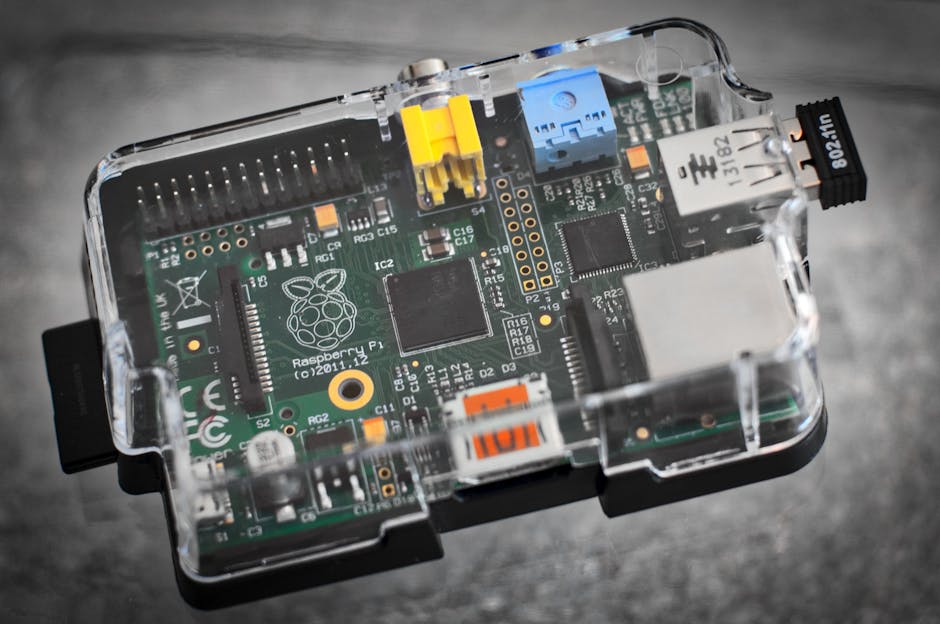
- Raspberry Pi: The gold standard for budget Home Assistant setups. It’s low-power and highly flexible.
- Old Laptops/PCs: That dusty laptop in your closet can easily run a Linux-based home automation server.
- Marketplace Buys: Check local second-hand sites. Many people sell older Echo Dots or Google Home Minis for next to nothing when they upgrade.
Using existing hardware can save you 50–75% on installation costs. This DIY approach not only saves money but builds a deeper understanding of your system. For more technical shortcuts, see our beginner-friendly assistant automation tips.
Software Strategies and Financial Frameworks
An easy assistant budget setup isn’t just about the physical gear; it’s about the software that runs it and the financial logic you use to manage it. You have two main paths: DIY Hub-Based (like Home Assistant) or Cloud-Based (like Alexa or Google Home).
| Feature | DIY Hub-Based (Home Assistant) | Cloud-Based (Alexa/Google) |
|---|---|---|
| Cost | Low (if repurposing hardware) | Moderate (device costs) |
| Privacy | High (Local data) | Lower (Cloud-dependent) |
| Difficulty | High (Requires setup) | Low (Plug and play) |
| Offline Function | Yes | Limited |
Choosing Software for Your Easy Assistant Budget Setup
On the financial side, your assistant should help you stick to proven frameworks like the 50/30/20 rule (50% needs, 30% wants, 20% savings) or the 60/30/10+15 plan.
To make this “easy,” leverage apps that offer smart automation:
- AI Receipt Scanning: Apps like ExpenseEasy use OCR (Optical Character Recognition) to extract data from receipts with 95% accuracy.
- Privacy-First Tracking: Look for tools that store data locally. Many techies prefer systems that don’t require direct bank access for better security.
- Free Calculators: Tools like BudgetBuddy allow you to create a budget in seconds without even signing up for an account.
For business-minded users, setting up a virtual PA business or tracking project costs can be done using plugins like those found in Easy8, which visualize finances through a Cost Breakdown Structure (CBS).
Maximizing ROI and Energy Efficiency
The “budget” in easy assistant budget setup refers to two things: the cost of the setup and the savings it generates. Smart home investments can lead to a 3–7% improvement in property value, but the immediate win is in your utility bills.
- Smart Thermostats: These can reduce annual energy bills by up to 26%. For the average household, that’s a saving of $150–$300 per year.
- Smart Plugs & Lighting: Automating these can shave another 10–20% off your electricity costs by ensuring devices aren’t drawing “vampire power” when not in use.
Total annual savings for a well-configured budget setup often range between $200 and $500. This means a $300 setup can literally pay for itself in less than 18 months. Explore more smart assistant energy saving tips to maximize your returns.
Security and Privacy Best Practices
As techies, we know that “cheap” shouldn’t mean “vulnerable.” A budget setup is only “easy” if it doesn’t lead to a security headache.
- Firmware Updates: Always keep your devices updated. Manufacturers frequently patch vulnerabilities.
- Network Segmentation: Put your smart devices on a guest Wi-Fi network. This keeps your main computer and financial data isolated if a smart bulb gets hacked.
- Local Data Ownership: Whenever possible, choose software that stores data on your device rather than the cloud. This is a core advantage of the DIY hub approach.
- No Bank Access: Use apps that allow manual entry or receipt scanning instead of linking your primary bank credentials if you are concerned about third-party breaches.
For those running multiple systems, connecting multiple smart assistants requires a careful look at which platform holds the “master” permissions.
Frequently Asked Questions about Budgeting Assistants
Can I repurpose an old computer for my setup?
Absolutely. An old laptop or a small form-factor PC is more than powerful enough to run Home Assistant. This is often more reliable than a Raspberry Pi because it includes built-in battery backup (the laptop battery) and faster storage.
What is the typical cost for a budget smart home?
A functional starter kit usually costs between $150 and $250. This covers a voice assistant, a few smart bulbs, and two or three smart plugs. A comprehensive setup with security and climate control usually sits around $450 to $500.
How do smart assistants help reduce utility bills?
They reduce bills through active management. This includes scheduling lights to turn off when you leave, using sensors to turn off heat in empty rooms, and identifying appliances that consume too much power via energy-monitoring smart plugs.
Conclusion
Creating an easy assistant budget setup is one of the most rewarding projects a financially savvy techie can undertake. By combining affordable hardware, smart repurposing, and automated financial frameworks, we can build a home that is both intelligent and economical.
At FinMoneyHub, we believe that complex command capabilities shouldn’t come with a complex price tag. Whether you are using a simple Google Home setup or a custom DIY hub, the goal remains the same: total control over your environment and your expenses.
Check out our latest breakdown of affordable smart assistants for home to find the perfect gear for your budget.
