
Build a Better Budget with These Routine Examples
Why FinMoneyHub Routine Examples Are the Fastest Path to Financial Clarity
FinMoneyHub routine examples give you a simple, repeatable system for building better money habits — no complicated spreadsheets or financial degrees required. Here’s a quick overview of the core routines:
Quick-Start FinMoneyHub Routine Examples:
| Routine | Time | Best For |
|---|---|---|
| Daily 2-minute check-in | 2 min | Everyone |
| Beginner daily routine | 5 min | New to tracking |
| Intermediate routine | 10 min | Building momentum |
| Advanced routine | 15 min | Debt payoff + investing |
| 72-hour spending audit | 3 days | Finding money leaks |
| 30-day couple’s plan | 30 days | Shared finances |
Financial literacy isn’t something you learn once and keep forever. Think of it more like fitness — the results come from small actions repeated often, not one big effort.
Here’s the uncomfortable truth: most money mistakes don’t happen because people don’t know better. They happen because knowledge breaks down under everyday pressure — at the checkout line, during a stressful week, or when a “limited time” sale appears on your screen.
That’s where daily routines change everything.
When you build a financial habit into your day — even just two minutes — you stop relying on motivation or memory. The good decision becomes automatic. Small daily check-ins compound over time, just like interest on an investment.
Research consistently shows that 37% of adults couldn’t cover a $400 emergency expense using cash. That’s not an income problem for most people. It’s a system problem. The fix isn’t earning more — it’s building habits that make the right choices easier.
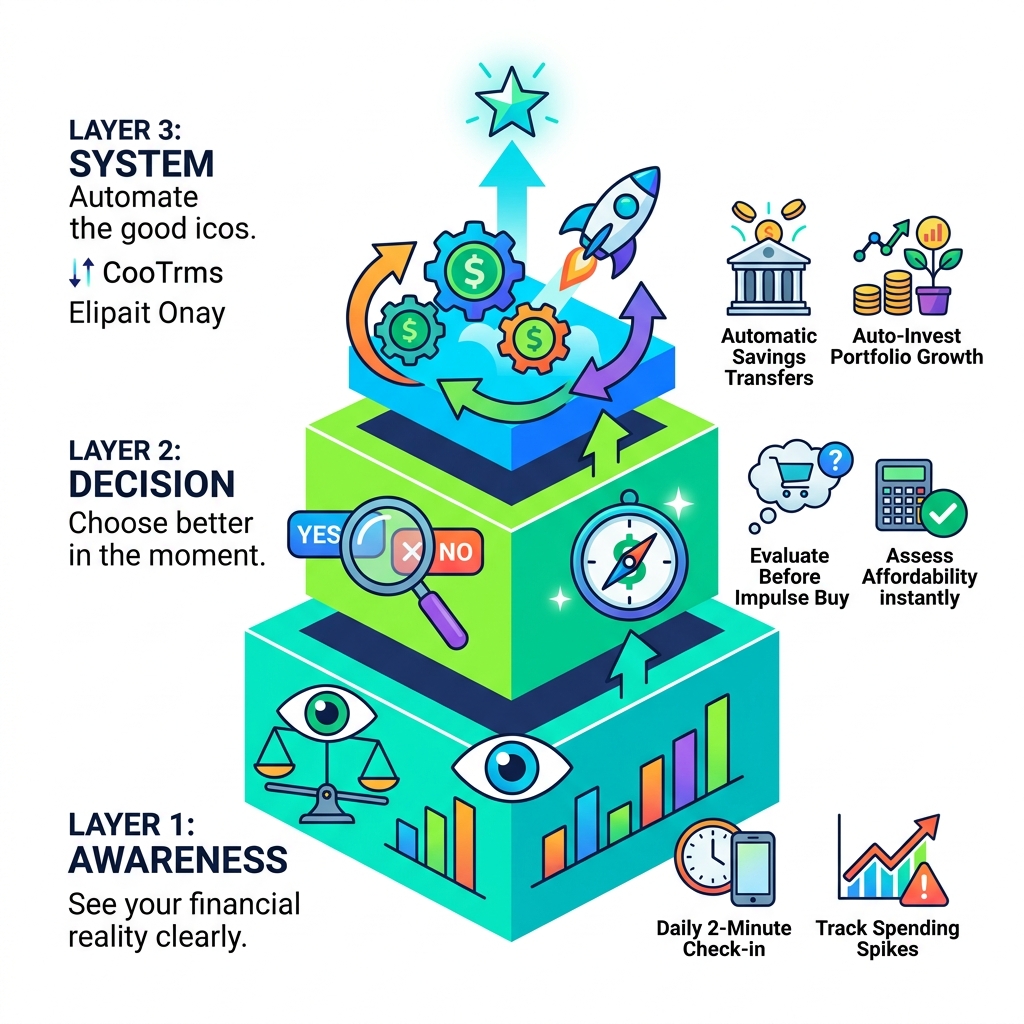
FinMoneyHub structures these habits into three layers:
- Awareness — See your financial reality clearly
- Decision — Choose better in the moment
- System — Automate the good choices so they happen without effort
The FinMoneyHub Daily Routine: Integrating Real-Time Data
At FinMoneyHub, we believe that data is the antidote to financial anxiety. Uncertainty is what keeps us up at night, wondering if we can afford that new laptop or if our portfolio is tanking. By integrating real-time data into your daily life, you replace “I think” with “I know.”
We utilize powerful data sources like the Finnhub API to fuel our finmoneyhub routine examples. This allows us to pull real-time stock quotes, company profiles, and market news directly into a dashboard or smart assistant. Imagine asking your smart display, “What’s the current price of my favorite tech stock?” and getting an instant answer from the /quote endpoint. Or, checking the /stock/profile2 endpoint to understand the fundamentals of a company before you buy their product.
A 2-minute check-in isn’t about deep analysis; it’s about checking the pulse. We look at real-time news and market metrics to see if our “financial weather” has changed. This habit turns financial literacy into “decision literacy”—the ability to apply knowledge in the heat of the moment.
Beginner FinMoneyHub Routine Examples (5 Minutes)
If you’re just starting, keep it simple. Your goal is awareness.
- Daily Balance Check: Open your banking app and look at your current balance. No judgment, just observation.
- Pending Transactions: Scan for any “ghost” charges or things you forgot you bought.
- Spendable Amount: Calculate what you have left for the day based on your weekly limit.
- Upcoming Bills: Use a bill radar to see what’s due in the next 48 hours.
Intermediate FinMoneyHub Routine Examples (10 Minutes)
Once the 5-minute check feels like second nature, we add a layer of strategy.
- Opportunity Cost Check: Before buying something non-essential, use real-time prices to see what that money could earn if invested instead.
- Portfolio News: Spend three minutes reading headlines related to the companies or ETFs you own.
- Categorization: Tag yesterday’s spending into “Needs,” “Wants,” or “Leaks.”
Advanced FinMoneyHub Routine Examples (15 Minutes)
For those ready to master their money, we dive into automation and deeper metrics.
- WebSocket Subscriptions: Set up real-time alerts for price movements or high-volume trades.
- Earnings Calendars: Check the upcoming week for earnings reports that might impact your holdings.
- Fundamental Data Review: Look at debt-to-equity ratios or revenue growth for your top three investments.
- Automated Alerts: Configure your system to notify you if your credit utilization crosses a certain threshold.
For more on how to set these up in your home, check out our guide on simple home automation routines.
Core Financial Literacy Habits for Every Level
Building wealth is less about the “big wins” and more about avoiding the “silent leaks.” Most people don’t overspend on rent; they overspend on $12 sandwiches and $15 streaming services they forgot they had.
| Feature | 72-Hour Audit | 30-Day Organization |
|---|---|---|
| Goal | Identify immediate leaks | Build a permanent system |
| Commitment | High intensity, short duration | Low intensity, long duration |
| Focus | Radical honesty & tracking | Infrastructure & automation |
| Best For | Breaking a spending spree | Couples or new investors |
One of our favorite finmoneyhub routine examples is the 24-hour rule. If it’s not a “Need,” it stays in the cart for 24 hours. This simple pause breaks the dopamine loop of impulse spending. Pair this with a purchase checklist: Do I need it? Is it planned? What will I give up to pay for it?
We also recommend a spending speed limit. Take your discretionary budget for the month and divide it by 30. That is your daily “cap.” If you go over today, you “borrow” from tomorrow.
The 72-Hour Spending Audit
Traditional budgets often fail because they are based on predictions. The 72-hour audit is based on reality. For three days, we practice radical honesty.
- Real-time logging: Use a notes app or a small notebook to record every cent the moment it leaves your hand.
- Needs vs. Wants vs. Leaks: At the end of the day, label each expense. A “leak” is something like a late fee, an unused subscription, or a convenience fee you could have avoided.
- Identifying Triggers: Did you buy that snack because you were hungry, or because you were stressed? Identifying the “why” is the first step to changing the “what.”
According to Finhabits, tracking spending without a budget for just 72 hours can reveal patterns that have been draining your account for years.
Smart Money Habits for Daily Success
To make these stick, we use “Identity Language.” Instead of saying “I’m trying to save,” say “I’m the kind of person who checks my balance daily.”
- One-sentence tomorrow plan: “Tomorrow I will spend money only on groceries and gas.”
- No-spend swaps: Instead of meeting a friend for a $30 brunch, suggest a walk in the park.
- One-touch receipt rule: Don’t let receipts pile up. Take a photo or log the expense the moment you get it.
For more tips on making your devices work for you, see our article on easy smart assistant routines.
Automating Financial Wellness with FinMoneyHub
Financial wellness isn’t a destination; it’s a set of metrics. Just like a fitness tracker monitors your heart rate, we monitor our financial vitals.
Monitoring the 6 Key Financial Metrics
We focus on these six numbers to ensure our routines are actually working:
- Savings Rate: We target a 15–20% savings rate. If you save $300 out of a $2,000 paycheck, you’re at 15%.
- Debt-to-Income (DTI): Keep this under 36% for an ideal profile; under 43% is the absolute limit for most lenders.
- Credit Utilization: Keep this below 30% to be “good,” but aim for under 10% for an “excellent” score.
- Emergency Fund: Start with 1–3 months of expenses; eventually, aim for 3–6 months.
- Net Worth Trend: It doesn’t matter where you start; it matters that the line is moving up.
- Cash Flow: Are you bringing in more than you’re sending out?
As noted in FinanceRoutine, daily habits turn these metrics from scary numbers into manageable goals. You can even automate these checks. For example, you can set an alert if your credit card balance exceeds 10% of your limit.
For beginners, check out our beginner-friendly assistant automation tips to see how to set up these alerts.
Specialized FinMoneyHub Routine Examples for Couples and Starters
Money is one of the leading causes of stress in relationships. Often, it’s not the amount of money that’s the problem—it’s the “financial fog” of not knowing who is paying for what.
Adapting FinMoneyHub Routine Examples for Couples
We recommend the “You/Me/Us” bucket system.
- Us Account: For shared bills (rent, groceries, utilities). We suggest an income-proportional split. If one partner earns 60% of the household income, they contribute 60% to the “Us” account.
- You & Me Accounts: Personal spending money that doesn’t require a conversation or permission. This preserves autonomy.
- Monthly Money Dates: A 20-minute, no-blame check-in to review goals and celebrate wins.
Adapting FinMoneyHub Routine Examples for Debt Payoff
If you’re focused on debt, your finmoneyhub routine examples should prioritize the “psychology of the win.”
- Debt Snowball: Pay off the smallest balance first for a quick dopamine hit.
- Debt Avalanche: Pay off the highest interest rate first to save the most money mathematically.
- Daily Micro-payments: If you find a $5 “leak” in your budget, immediately send that $5 to your credit card. Don’t wait until the end of the month.
To learn how to use voice commands for these tasks, see our guide on the best routines for smart assistants.
The 72-Hour Quick-Start Framework
Want to launch your routine this weekend? Follow this 72-hour framework:
- Hour 1-24: Account Gathering. List every account, login, and balance. No hiding.
- Hour 25-48: Payment Calendar. Map out every bill due date for the next 30 days.
- Hour 49-72: Automation Setup. Set up a $25 weekly auto-transfer to an emergency fund and turn on “Auto-pay” for minimum debt payments.
Frequently Asked Questions about FinMoneyHub Routines
How many daily money habits do I need to start?
Start with exactly two: the 2-minute money check-in and the 24-hour purchase pause. That’s it. If you try to do fifteen habits on day one, you will quit by day three. Consistency beats perfection every single time. Once those two feel as natural as brushing your teeth, add one more.
What if I miss a day in my financial routine?
Life happens. You might get sick, have a busy day at work, or just forget. The rule is: Never miss twice. If you miss Monday, make sure Tuesday’s check-in happens. Use “Identity Language” to get back on track—remind yourself that you are a person who values financial clarity.
Can I use FinMoneyHub’s data features if I don’t know how to code?
Absolutely. While we use advanced data like the Finnhub API, you don’t need to be a developer to benefit. You can use AI agent skills or low-code tools to bridge the gap. For example, you can learn how to build a finnhub-api agent skill using simple templates that work with your smart assistant. This allows you to get real-time data using simple voice commands or basic app integrations.
Conclusion
Building a better budget isn’t about restriction; it’s about direction. By using these finmoneyhub routine examples, you are taking the wheel of your financial life. Whether you are living paycheck-to-paycheck or looking to optimize a growing portfolio, the secret lies in the daily micro-habit.
At FinMoneyHub, our goal is to make these complex commands easy for your smart devices, so you can focus on what matters most. Financial freedom isn’t a lottery win; it’s the result of 2-minute check-ins, 24-hour pauses, and a commitment to radical honesty.
Ready to take the next step in automating your life? Start your journey with our beginner guide to smart plugs to see how hardware and software can team up to save you money on your utility bills every single day.
