
Let AI Handle the Math with Expense Automation
The Real Cost of Sorting Expenses by Hand
Expense categorization automation is the use of AI, machine learning, and OCR technology to automatically sort business transactions into the correct accounting categories — replacing manual data entry with instant, accurate classification.
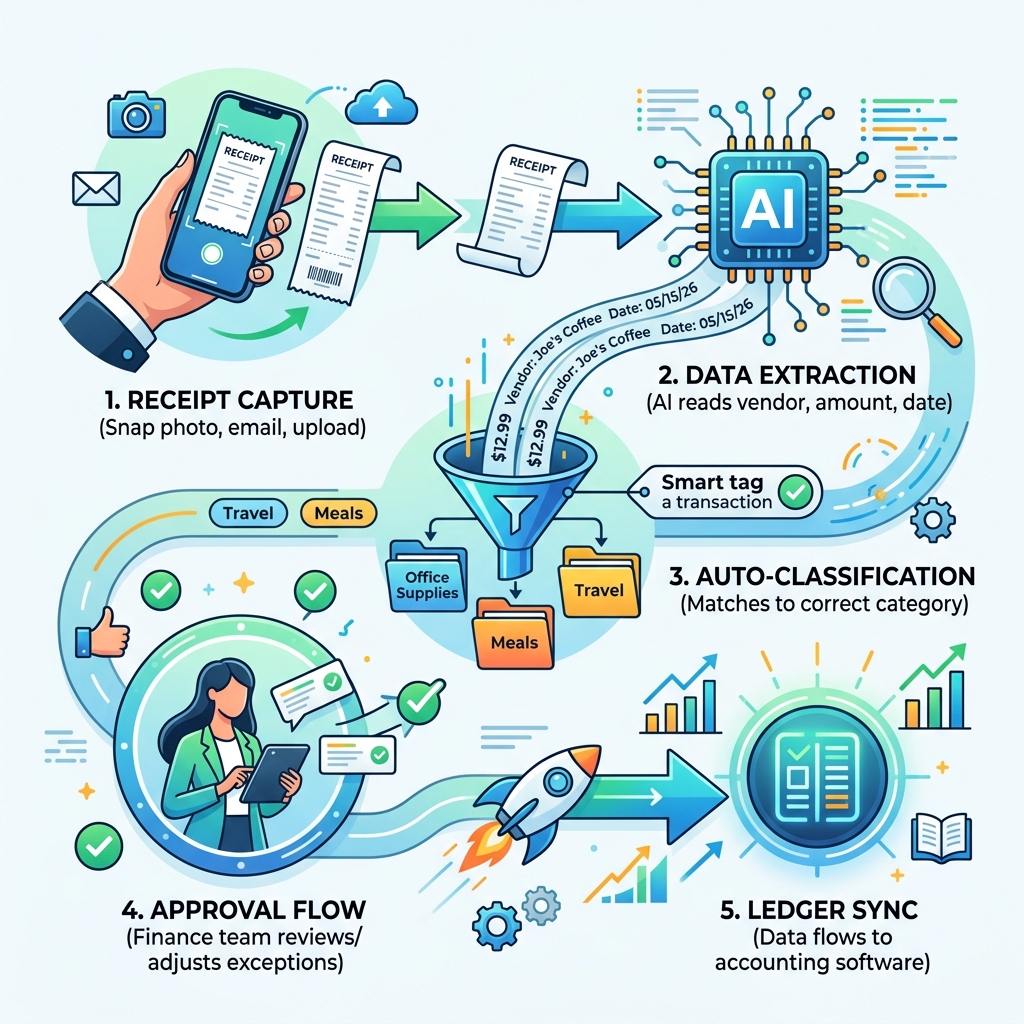
Here’s how it works at a glance:
- Capture – Receipt is scanned, emailed, or uploaded
- Extract – AI reads vendor name, amount, date, and line items
- Classify – Transaction is matched to the right expense category
- Sync – Data flows directly into your accounting software
- Review – Finance team approves or adjusts flagged items
Think of it as a tireless bookkeeper who never misreads a receipt.
Manual expense management sounds manageable — until you see the numbers.
The average 200-person company burns through 330 hours every year just processing expense reports. Each report takes about 20 minutes to complete. And nearly 1 in 5 contains errors, which then require another 18 minutes to fix.
The cost adds up fast. Processing a single expense report manually runs about $58. Automation brings that down to $10.
That’s not a small efficiency gain. That’s a fundamental change in how finance teams spend their time.
Finance teams end up chasing receipts instead of analyzing data. Approvals drag on for days. Errors slip through. And by the time month-end rolls around, reconciliation feels like archaeology.
The good news? AI tools have made automated expense sorting accessible to businesses of every size — from solo freelancers to global enterprises.
The Mechanics of expense categorization automation
To understand how expense categorization automation actually works, we have to look under the hood at the “Big Four” technologies: OCR, NLP, Pattern Recognition, and Adaptive Learning.
Optical Character Recognition (OCR) is the first responder. It looks at a photo of a crumpled lunch receipt and turns those pixels into data. While old-school OCR often missed details, modern AI-driven extraction hits 95-99% accuracy. It doesn’t just see “Starbucks”; it sees the date, the VAT amount, and the specific line items.
Next, Natural Language Processing (NLP) interprets the text. If you type “spent $45 at Uber Eats” into a smart assistant, NLP understands that “Uber Eats” is the merchant and “$45” is the value. It bridges the gap between how humans talk and how databases store information.
Pattern recognition and adaptive learning then take over. If we always categorize your “Adobe” subscription under “Software,” the system remembers. It identifies recurring vendors and predicts the category before you even open the app. This isn’t just a rigid set of rules; it’s a system that gets smarter with every transaction you approve.
How AI Agents Interpret Financial Context
Modern systems use “AI Agents” rather than simple software. These agents perform contextual analysis. For example, a charge from “Chevron” could be “Fuel” for a delivery truck or “Travel” for a sales rep. The AI looks at transaction metadata—time, location, and historical employee behavior—to make an educated guess.
Most advanced tools now provide a “confidence score.” If the AI is 99% sure, it auto-categorizes. If it’s only 70% sure (perhaps it’s a new vendor), it flags the item for a quick human “thumbs up.” This ensures that expense categorization automation remains accurate even as your business spending evolves.
The Role of RAG and Machine Learning
One of the most exciting developments in fintech is Retrieval-Augmented Generation (RAG). Instead of just relying on a general AI model, RAG allows the system to look at your company’s specific “Chart of Accounts.”
The system uses vector search to find similar historical transactions in your own database. If your business uses a unique code for “Client Entertainment – High Value,” the RAG architecture retrieves that specific context and applies it. It creates a personalized experience where the AI learns your specific business language, ensuring your ledger stays consistent year over year.
Why Businesses are Switching to AI-Powered Sorting
The shift toward automation isn’t just about following a trend; it’s about survival in a market. When we look at the data, the manual approach is simply unsustainable.
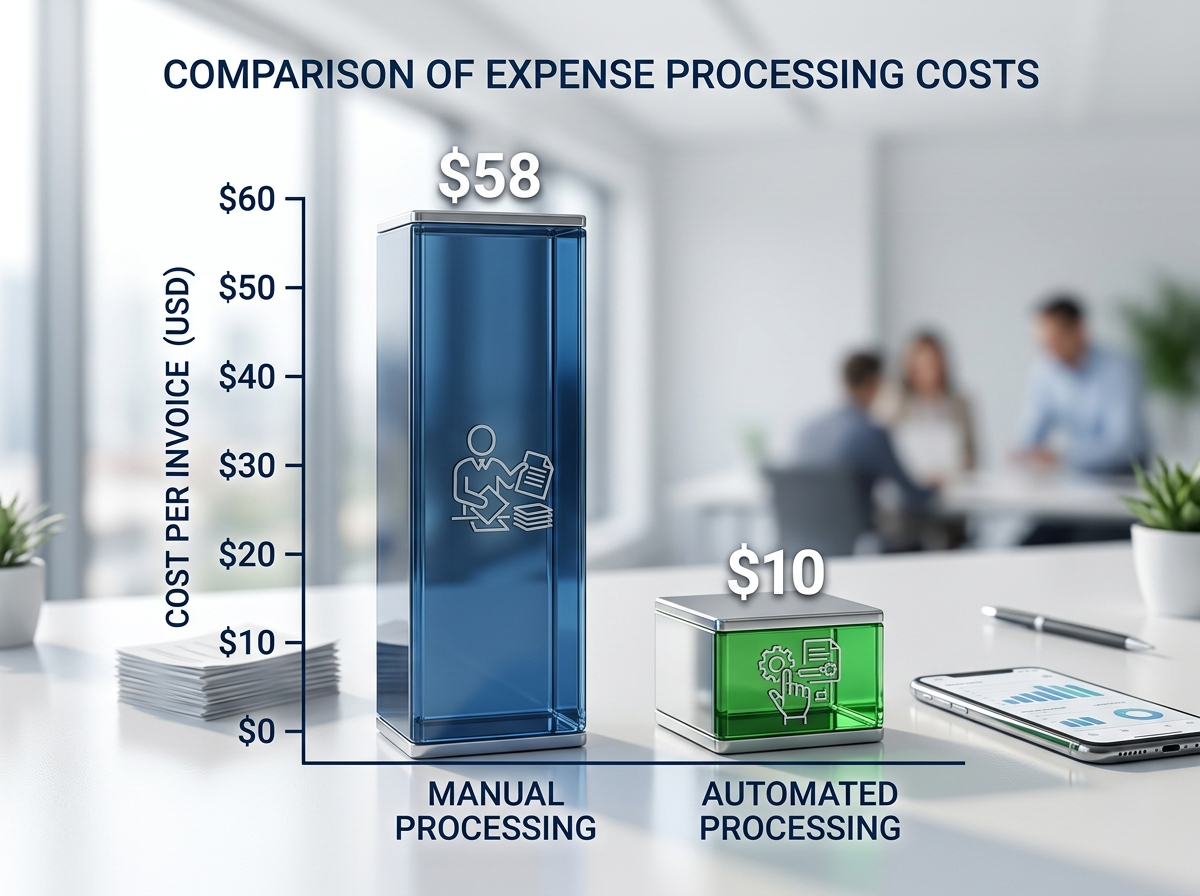
Beyond the 67% reduction in processing time, there are several strategic reasons to make the switch:
- Error Reduction: With manual entry, 19% of reports contain mistakes. AI doesn’t get tired or mistype a decimal point.
- Fraud Detection: Automation can instantly flag duplicate receipts or transactions that violate company policy.
- Real-Time Visibility: Instead of waiting for the end of the month to see how much was spent, we get a live dashboard of company health.
- Audit Readiness: Every transaction comes with a digital paper trail, including the original receipt image and a timestamped approval. This makes tax season significantly less stressful.
Key Features of Modern expense categorization automation Systems
If you are looking to upgrade your tech stack, there are several “must-have” features that define a top-tier automation system:
- Policy Enforcement: The system should automatically block or flag expenses that exceed a certain limit or fall into “prohibited” categories.
- Approval Workflows: Multi-stage approvals ensure that the right manager sees the right expense at the right time.
- Duplicate Detection: AI compares new uploads against historical data to ensure you never pay for the same lunch twice.
- Natural Language Querying: Imagine asking your smart assistant, “How much did we spend on SaaS last month?” and getting an instant, categorized answer.
Real-Time Syncing with Accounting Software
The true power of expense categorization automation is realized when it talks to your accounting software. Through API integrations, these tools map your expenses directly to your ledger in QuickBooks, Xero, or Sage.
This creates a “closed-loop” system where reconciliation happens almost instantly. For those looking to optimize their entire business environment, using smart sensors for energy efficiency can offer similar automated benefits for your physical workspace, creating a truly “smart” business operation.
Mobile Accessibility and Multi-Currency Support
In 2025, business doesn’t just happen at a desk. Mobile accessibility is crucial. Whether it’s snapping a photo on a smartphone or forwarding an invoice via WhatsApp, the “capture” phase should be frictionless.
For international businesses, multi-currency support is a game-changer. AI can now detect currency symbols, extract the original amount, and apply real-time exchange rates to convert the transaction into your base currency. This handles the “cross-border” headache automatically, ensuring your VAT and tax categories are compliant regardless of where the purchase was made.
Steps for Implementing expense categorization automation
Ready to make the jump? We recommend a structured approach to ensure the transition is smooth:
- Process Assessment: Look at your current “pain points.” Are receipts getting lost? Are reimbursements taking too long?
- Software Selection: Choose a tool that fits your company size. Startups might prioritize speed and low cost, while enterprises need deep policy controls.
- Employee Training: Show your team how much easier their lives will be when they don’t have to manually type out expense reports.
- System Optimization: After a month, review the AI’s “corrections.” Use these insights to fine-tune your categories.
Implementing these systems is much like setting up a smart office. Just as you might look for best energy-efficient smart gadgets to streamline your home or office, choosing the right financial software streamlines your digital workflow.
Overcoming Implementation Challenges
Of course, no transition is without hurdles. Data quality is often the biggest roadblock—if your historical records are messy, the AI has a harder time learning. We suggest a “clean slate” approach where you validate your Chart of Accounts before syncing.
Organizational resistance is another factor. Some team members may fear that AI is “taking over.” It’s important to frame automation as a tool that removes the “grunt work,” allowing them to focus on high-level financial strategy rather than data entry.
Choosing the Right Solution for Your Business Stage
Your needs will change as your business grows. Here is a quick breakdown of what to look for at different stages:
| Feature | Expense Tracking (Small Biz) | Spend Management (Scale-up/Enterprise) |
|---|---|---|
| Primary Goal | Recording past spending | Controlling future spending |
| Key Tool | Receipt Scanning Apps | Virtual/Corporate Cards |
| Automation | Basic OCR & Categorization | Real-time policy blocking |
| Integrations | Simple Ledger Sync | Deep ERP Integration |
For startups, look for tools that offer virtual cards with built-in spending limits. This allows you to give employees the freedom to buy what they need (like easy energy-saving smart devices) while ensuring the expense is automatically categorized and capped.
Frequently Asked Questions about Expense Automation
Does automated categorization replace accountants?
Not at all. Think of it as giving your accountant a superpower. Instead of spending 80% of their time on data entry and “chasing receipts,” they can spend that time on tax strategy, cash flow forecasting, and financial advice. The AI handles the “math,” but the accountant provides the “meaning.”
How accurate is AI-driven receipt extraction?
Modern systems are remarkably accurate, often reaching 95% to 99% field-level accuracy. Because the AI uses “confidence scoring,” it will flag the 1% of messy or ambiguous receipts for human review, ensuring that your books remain “audit-perfect.”
Can automation handle international tax compliance?
Yes. Many AI-powered tools are now “tax-aware.” They can research and apply current tax rules based on your jurisdiction (like UK VAT or US Sales Tax). They can even flag potentially deductible expenses that a human might miss, citing official sources like the IRS or HMRC.
Conclusion
At FinMoneyHub, we believe that the future of business lies in smart assistant routines and complex command capabilities. Why spend your valuable time on repetitive manual tasks when you can delegate them to an intelligent system?
Expense categorization automation is more than just a convenience—it’s a cornerstone of modern financial efficiency. By letting AI handle the math, you reduce errors, save thousands of dollars in processing costs, and gain real-time visibility into your company’s health.
Whether you are a freelancer looking to simplify your tax season or a growing enterprise aiming for a 5x faster reimbursement cycle, the tools are ready for you. It’s time to stop sorting and start growing.
Start your smart financial journey today and discover how digital transformation can reclaim your time.
