
The Best Circadian Rhythm Smart Lighting for a Better Night’s Sleep
Why Your Light Bulbs Are Quietly Wrecking Your Sleep
Circadian rhythm smart lighting is the easiest way to align your home’s lights with your body’s natural 24-hour sleep-wake cycle — and the top options worth considering are:
- Philips Hue White Ambiance — best for whole-home automation and ecosystem depth
- TUO Circadian Smart Bulb — best for science-backed, app-driven daily light modes
- NorbSMART A19/BR30 — best value for dedicated circadian spectrum control
- Aqara LED Bulb T2 + Hub M3 — best for local, hub-based automation and HomeKit users
- GE Cync tunable white bulbs — best budget entry point for beginners
Read on for the full breakdown of each option, setup tips, and how to automate everything with minimal effort.
Here’s something most people don’t realize: your light bulbs are probably the biggest thing standing between you and a good night’s sleep.
Before electricity, humans woke with bright morning light and wound down under dim, warm firelight. Today, we sit under the same harsh, cool-white bulbs at 10 PM that we use at 10 AM. Your brain can’t tell the difference — and that’s a real problem.
Research from the Sleep Foundation shows that exposure to cool-tone artificial lighting after sunset can delay sleep onset by 30 to 60 minutes. Over time, that adds up to a serious sleep deficit.
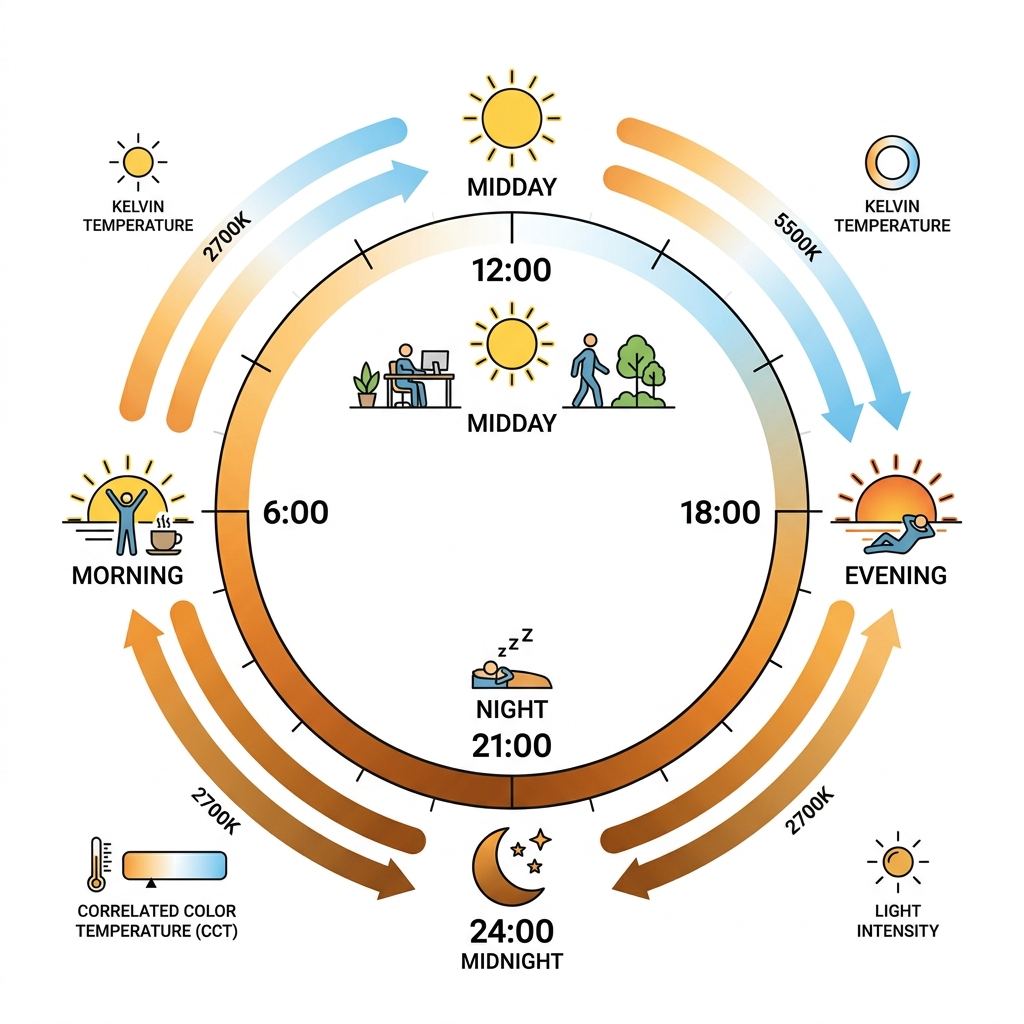
Circadian smart lighting fixes this automatically. It shifts your lights from cool and bright during the day to warm and dim in the evening — mimicking the sun’s natural arc. Studies suggest this kind of schedule can improve sleep quality by 20 to 30%.
The best part? Once it’s set up, it runs itself. No manual adjustments, no remembering to dim the lights before bed.
The Science Behind Circadian Rhythm Smart Lighting
To understand why circadian rhythm smart lighting is such a game-changer, we have to look inside our own heads. Deep in the brain lies the Suprachiasmatic Nucleus (SCN), a tiny region that acts as our master biological clock. This internal timekeeper relies almost entirely on light signals to tell our bodies what time it is.
When morning light hits our eyes, the SCN triggers the release of cortisol, the hormone that makes us feel alert and ready to tackle the day. As the sun sets and light shifts to warmer, redder tones, the brain is supposed to start producing melatonin—the “sleep hormone.”
The problem? Modern LED bulbs often emit a heavy dose of blue light. While blue light is great at noon for productivity, it is a disaster at 9 PM. Blue light suppresses melatonin production more than any other wavelength. When we keep our homes bright and “cool” (bluish-white) late into the evening, we create a biological mismatch. We are essentially tricking our brains into thinking it’s midday, even when we’re trying to wind down.
This is where the concept of “light nutrition” comes in. Just as we think about the quality of the food we eat, we should consider the quality of the light we consume. Scientific research suggests that implementing understanding smart light scheduling for beginners can lead to a 30% sleep improvement. By aligning indoor light with the sun’s natural transition, we can finally stop fighting our own biology.
Key Benefits of Circadian Rhythm Smart Lighting
The advantages of switching to a circadian-friendly setup go far beyond just falling asleep faster. Here is what you can expect when you align your home with your biological clock:
- Superior Sleep Quality: By allowing melatonin to rise naturally in the evening, you achieve deeper, more restorative sleep.
- Stabilized Mood: Proper light exposure helps regulate the endocrine system, which can reduce feelings of lethargy or agitation.
- Enhanced Productivity: Bright, cool light during work hours boosts concentration and alertness, helping you power through tasks without the mid-afternoon “slump.”
- Reduced Eye Strain: Smart bulbs that flicker less and provide high-quality color rendering (Ra90 CRI) are much gentler on the eyes during long hours of indoor activity.
- Easier Mornings: Simulating a sunrise helps reduce “sleep inertia”—that groggy, heavy feeling we often have right after waking up.
How Light Exposure Affects Your Internal Clock
Our eyes contain specialized cells that are particularly sensitive to a specific range of blue light: the 460-490nm wavelength range. This is the “daytime” signal. When these cells detect this light, they tell the brain to stay awake.
In a natural environment, this wavelength disappears as the sun goes down. In a modern home, it stays present until we flip the switch. This delay in the signal means our bodies don’t start the 2-hour “wind-down” process until much later than they should. By using adaptive lighting solutions, we can ensure that these specific wavelengths are phased out as the evening progresses, allowing our internal clocks to stay perfectly synced with the outside world.
How to Choose the Best Smart Bulbs for Your Biological Clock
When shopping for circadian rhythm smart lighting, you’ll see two technical terms everywhere: CCT and Kelvin. CCT stands for Correlated Color Temperature, measured in Kelvin (K).
Lower Kelvin numbers (1800K–2700K) mean the light is “warm” and orange-toned, like a candle or a sunset. Higher Kelvin numbers (5000K–6500K) mean the light is “cool” and bluish, like a bright overcast day. To get the most out of your smart home, you need “tunable white” bulbs that can travel across this entire spectrum.

Ideal Kelvin and Brightness by Time of Day
| Time of Day | Ideal Kelvin (CCT) | Brightness Level | Purpose |
|---|---|---|---|
| Early Morning | 5000K – 6500K | 80% – 100% | Boost cortisol and alertness |
| Midday | 4000K – 5000K | 100% | Maintain focus and productivity |
| Late Afternoon | 3000K – 4000K | 70% – 80% | Begin gentle transition |
| Evening | 2200K – 2700K | 30% – 50% | Stimulate melatonin production |
| Night | 1800K – 2000K | 1% – 10% | Minimal disruption for sleep |
Essential Features of Circadian Rhythm Smart Lighting Bulbs
Not all smart bulbs are created equal. If you are serious about your health, look for these specific features when finding the best beginner-friendly smart lighting:
- Wide Tunable White Range: Look for bulbs that go as low as 2000K (or even 1800K) for the evening and up to 6500K for the morning.
- Ultra-Low Dimming: A bulb that can dim down to 1% is essential for “night modes” that won’t wake you up during a midnight trip to the bathroom.
- High Color Rendering Index (CRI): A Ra90 CRI rating ensures colors look natural and vibrant, which reduces eye strain.
- Flicker-Free Technology: Cheap LEDs often flicker at a rate invisible to the eye but detectable by the brain, leading to headaches.
- App & Voice Control: You want the ability to override your schedule via voice or phone if your plans change.
Ideal Color Temperatures for Daily Routines
We recommend setting your lights to 6500K for the first hour of your day to jumpstart your brain. During the core work hours, 4000K provides a neutral, clean light that is perfect for reading and detail-oriented tasks. As you hit the evening, drop to 2700K—the classic “warm white” of old-fashioned incandescent bulbs. Finally, if you’re up late, shifting to a deep amber 1800K at low brightness is the ultimate way to protect your sleep.
Recommended Smart Lighting Solutions for Natural Sleep and Wake Cycles
Now that we know the “why,” let’s look at the “what.” We have tested several systems that make implementing circadian rhythm smart lighting effortless.
Philips Hue: The Gold Standard
Philips Hue is arguably the most polished ecosystem. Their White Ambiance range is specifically designed for this purpose. Within the Philips Hue app, you can find the “Natural Light” scene, which automatically transitions your bulbs through the correct temperatures throughout the day. For a dedicated bedside solution, the Philips Hue Twilight lamp features a dual light source and ultra-low dimming that can simulate a dawn so gentle you’ll forget you’re using an artificial light.
TUO: The Science-First Choice
If you want something backed by specific neuroscience research, TUO Circadian Smart Products are a fantastic choice. Developed in conjunction with research from the University of Washington, these bulbs use a patented UV-free technology that targets the eye’s circadian receptors more effectively than standard LEDs. Their app features simple modes like WAKE, ACTIVE, and CALM to take the guesswork out of scheduling.
NorbSMART: Light as Nutrition
NorbSMART bulbs are unique because they combine two different specialized spectra in one bulb: “NorbSMILE” (sunlike daytime spectrum) and “NorbSLEEP” (melatonin-enhancing evening spectrum). They are a great high-value option for those who want specialized wellness lighting without a massive price tag.
Aqara: The Automation Powerhouse
For those who love a truly smart home, the Aqara LED Bulb T2 paired with the Hub M3 offers incredible local automation. Unlike some systems that rely on the cloud, Aqara’s circadian scenes can run even if your internet goes down. You can also pair them with presence sensors to ensure the light temperature adjusts the moment you walk into a room. You can discover more of our top picks for circadian lighting on our dedicated category page.
Setting Up Automations for a Healthier Home
The magic of circadian rhythm smart lighting is that it should be “invisible.” You shouldn’t have to think about it. At FinMoneyHub, we specialize in creating complex command routines that make your devices work for you.
A basic automation should include a sunrise simulation, where your bedroom lights slowly brighten over 30 minutes before your alarm goes off. In the evening, a sunset fade should begin about two hours before your desired bedtime, gradually shifting the house from 4000K to 2200K.
To make this even better, consider adding motion sensors. For example, a sensor in the bathroom can be programmed to turn on a very dim, 1800K light if triggered between midnight and 6 AM. This allows you to see where you’re going without “resetting” your brain to daytime mode. If you’re new to this, check out our introduction to voice-controlled smart lights or our beginner-friendly guide to installing smart bulbs.
Creating a Circadian Schedule in Popular Apps
Most major platforms now have built-in tools for this:
- Philips Hue: Use the “Natural Light” scene in the Scene Gallery. It’s a “set it and forget it” solution.
- Apple HomeKit: Look for “Adaptive Lighting.” Compatible bulbs (like those from Aqara or Philips Hue) will show a dedicated icon that automatically adjusts color temperature based on the sun’s position in your specific location.
- Home Assistant: For the tech-savvy, the “Adaptive Lighting” integration offers the most control, allowing you to set specific offsets for sunrise and sunset.
If you’re looking for a quick start, our quick and easy smart lamp setup tutorial will get you up and running in minutes.
Common Mistakes to Avoid with Smart Lighting
Even with the best bulbs, you can accidentally ruin your progress. Avoid these common pitfalls:
- Blue Light Leakage: Ensure your “warm” scenes don’t accidentally include a stray “cool” bulb in a corner lamp.
- Brightness Too High: Even warm light can suppress melatonin if it is too bright. Keep evening levels below 50%.
- Eye-Level Placement: Whenever possible, use floor lamps or low-level lighting in the evening. Light hitting the bottom of the retina (from sources above eye level) is more likely to trigger a “wake up” response.
- Ignoring Screens: Your smart lights won’t help much if you’re staring at a bright blue smartphone screen until midnight. Use “Night Shift” or “Blue Light Filter” modes on all your devices.
For more help with fine-tuning, read our helpful tips for smart light dimming.
Frequently Asked Questions about Circadian Lighting
Can smart lighting really help me fall asleep faster?
Yes! By reducing blue light exposure in the 60–90 minutes before bed, you allow your body to produce melatonin on its natural schedule. Studies have shown that users of circadian lighting systems often fall asleep 30% faster than those under standard static lighting.
Do I need a special hub for circadian lighting?
It depends on the brand. While some Wi-Fi and Bluetooth bulbs work directly with your phone, we usually recommend a hub (like the Hue Bridge or Aqara M3). Hubs allow for more reliable, local automations that don’t rely on your phone being nearby or your Wi-Fi being perfect. They also support protocols like Zigbee, which are better for smart assistant routines for controlling lights.
What is the best light temperature for evening reading?
We recommend a temperature between 2700K and 3000K. This provides enough contrast to see the text clearly without flooding your eyes with the blue light that suppresses melatonin. If you find it too dim, increase the brightness slightly rather than switching to a cooler color temperature. You can also use smart light sensors to automatically trigger these reading scenes when you sit in your favorite chair.
Conclusion
Investing in circadian rhythm smart lighting is one of the most impactful upgrades you can make to your home. It is more than just a “cool tech” feature; it is a fundamental tool for long-term wellness. By aligning your indoor environment with the natural world, you are giving your body the signals it needs to perform at its best—whether that’s focusing on a complex work project or drifting into a deep, peaceful sleep.
Resetting your body clock doesn’t happen overnight, but with the right smart bulbs and a few simple automations, you’ll be amazed at how much better you feel in just a few weeks. Ready to start your journey? Explore the FinMoneyHub Smart Lighting Category for more guides and product recommendations.
